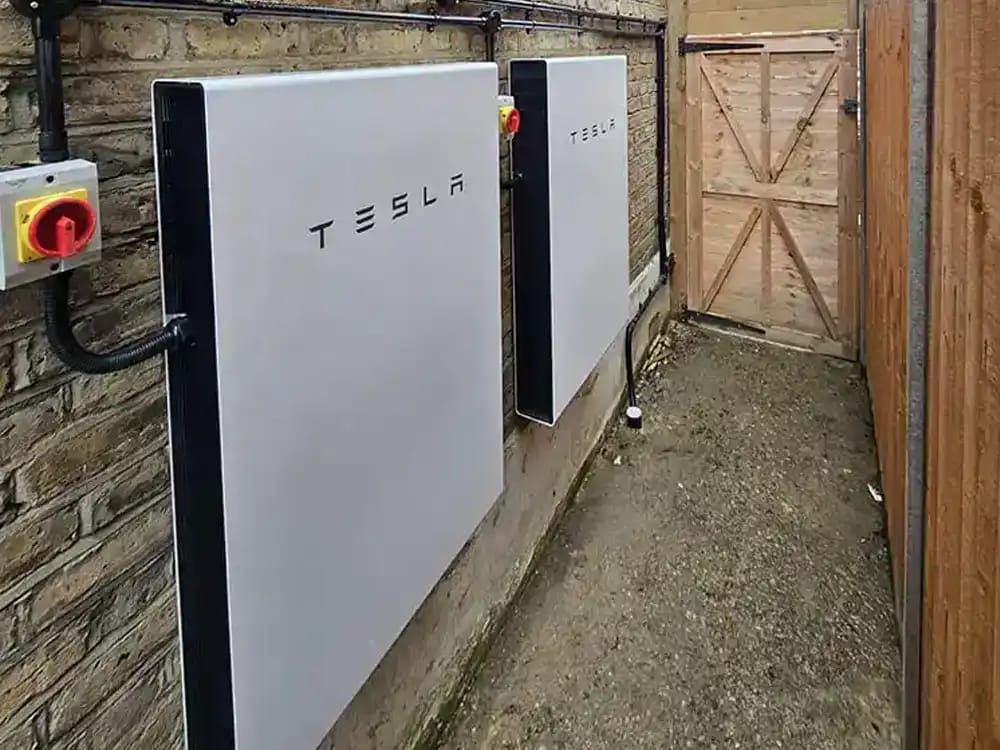
A 13.5 kWh home battery: for high usage, an EV, a heat pump, or whole-home backup
The 13.5 kWh tier is the top of the mainstream home battery range, and it exists for households that genuinely need the extra capacity. That means high-usage homes getting through 4,500 kWh a year or more, homes with an electric vehicle to charge, homes running a heat pump, and anyone who wants whole-home backup through a power cut. The flagship of this tier is the Tesla Powerwall 3, at 13.5 kWh usable with 100 percent depth of discharge and an integrated backup gateway, and it is stackable to three units, or 40.5 kWh, for very large loads.
The important caveat comes first: only buy this tier if your usage genuinely fills it. A 13.5 kWh battery in a 3,000 kWh a year house will only ever part-cycle, so you will have paid for capacity you never earn back, and the payback stretches well past 10 years. If your usage is average, a 10 kWh battery is almost certainly the better buy. We size to what your home actually uses, and we will tell you honestly if a large battery is more than you need.
Who it suits
A 13.5 kWh system suits high-consumption households, EV owners who want to charge from stored cheap or solar power, heat-pump homes with a heavier winter electrical load, and anyone whose priority is whole-home backup. It handles an EV charge and a heat pump alongside normal household load, which a smaller battery cannot. Because it is stackable, it also suits homeowners who expect their usage to grow, for example when a second EV arrives.
How it works
At this size the continuous power rating matters as much as the capacity, typically 5 to 11.5 kW, because you may be running an EV charger, a heat pump and the house at once. The Powerwall 3's 100 percent depth of discharge means its full 13.5 kWh is usable, which is not true of every battery, so as always compare quotes on usable kWh. It works in all modes: storing solar, arbitrage on a smart tariff, and backup, and with solar it can recharge itself during a longer daytime outage. Tesla Powerwall is always AC-coupled; other large batteries may be DC-coupled on a new solar install for higher efficiency.
Realistic cost and payback
A 13.5 kWh home battery typically costs £8,000 to £11,500 installed including 0 percent VAT, and larger 16 kWh-plus systems run £12,000 to £16,000. As a supply reference, the Powerwall 3 is around £5,600 to supply plus roughly £1,750 to install. Payback usually lands around 9 years, longer than the smaller tiers, because you are storing more energy and the extra capacity only pays if it is used. Annual savings for a home that genuinely fills a 13.5 kWh battery run in the region of £600 to £750 a year from arbitrage and solar self-consumption, and more where an EV and heat pump load is being shifted to cheap power.
Getting the size right
This tier is right when your annual usage is 4,500 kWh or above, or when an EV, a heat pump or a backup requirement pushes your daily need beyond what a 10 kWh battery can carry. The test is simple: will you cycle most of the capacity most days? If yes, the larger battery earns its keep; if not, size down. The savings calculator gives a first estimate, and a proper survey of your consumption, EV charging and heating pattern confirms whether 13.5 kWh, a stacked system, or a 10 kWh unit is the right fit.
Key considerations
- Only size up if you fill it: the single biggest mistake at this tier is buying capacity you never cycle. Match the battery to genuine high usage.
- Power rating: check the continuous kW is enough to run an EV charger, heat pump and house together if that is your situation.
- Backup: if whole-home backup is the goal, specify it up front; the Powerwall 3's integrated gateway is built for this, with automatic switchover.
- DNO and planning: a 13.5 kWh system will usually be above 3.68 kW per phase, so notified under G99 rather than G98; still permitted development, no planning permission for almost all homes.
- Safety and warranty: LFP only, to BS 7671 and PAS 63100 by an MCS-registered, RECC-backed installer. Tesla warrants the Powerwall 3 for 10 years with unlimited cycles; other quality LFP batteries warrant around 6,000 to 10,000 cycles or 10 to 12 years to roughly 70 to 80 percent capacity.
- Manufacturer stability: a large, expensive battery makes warranty security especially important. GivEnergy entered administration in April 2026, putting its warranty support, firmware and spares in serious doubt, so we would not recommend a new GivEnergy system. We compare independent installers and weigh manufacturer stability in every recommendation.
An illustrative example
As an illustrative composite, not a named customer: a detached rural home with a 5 kWp array and an EV on the drive used about 6,500 kWh a year and had lost power for a full day twice in two winters. They fitted a 13.5 kWh usable Tesla Powerwall 3 with its integrated backup gateway, DC-coupled to the solar, for around £11,000 including 0 percent VAT, with the DNO approving a G99 application. In the model, whole-home backup kept lights, fridge, freezer, broadband and heating running through outages with automatic switchover, while daily arbitrage and solar self-consumption, including cheap overnight EV charging, saved about £690 a year, a payback near 9.4 years with the resilience treated as the real reason for the buy. The figures are illustrative and depend on your usage, EV and heating load, and tariff.
If your usage genuinely fills it, the 13.5 kWh tier delivers the most capacity and the strongest backup. Run the savings calculator, read the cost guide, or get an honest quote that checks whether you really need this much. The FAQs cover the Tesla Powerwall and backup questions, the backup power page goes deeper on resilience, and you can compare the popular 10 kWh sweet spot if your usage is more average.
Typical large system (13.5 kwh+) - high usage / backup install
- Usable capacity
- 5-11.5 kW / 13.5-27 kWh usable
- Installed cost (0% VAT)
- £8,000-£16,000 (0% VAT)
- Payback
- 9 years
- Annual CO₂ saved
- 0.7-1.4 tonnes
Get a free large system (13.5 kwh+) - high usage / backup quote
Responds within one working day
- 1. A quick call to understand your home, usage and what you want the battery to do.
- 2. Compared quotes from independent, MCS-registered installers — sized honestly, with a realistic payback.
- 3. Install and aftercare by MCS-certified engineers, 0% VAT applied.
- MCS Certified
- NICEIC
- RECC
- TrustMark