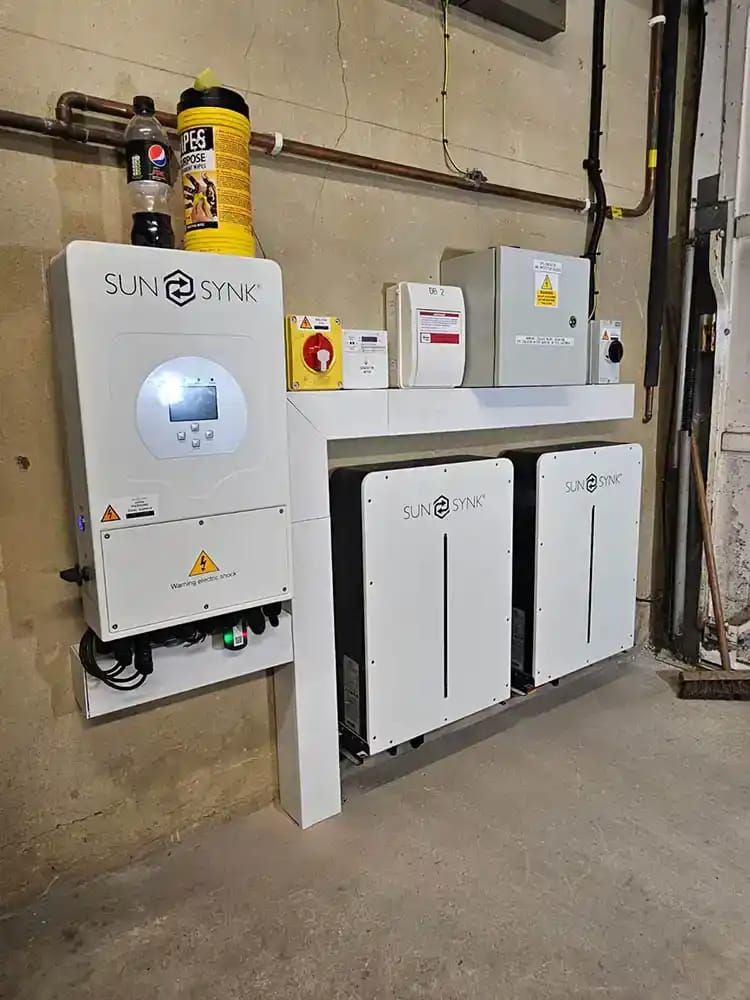
Whole-home backup and EPS: keeping the lights on when the grid goes down
A standard home battery does nothing for you in a power cut. For safety, a normal grid-tied battery shuts down the moment the grid fails, so it cannot inadvertently send power back into lines that engineers may be working on. If you want your home to keep running through an outage, the battery has to be specified for backup from the start, with the right kit and wiring. That is what a backup or EPS system provides: lights, fridge and freezer, broadband, boiler and other essentials staying on when everyone else is in the dark.
There are two levels. EPS, Emergency Power Supply, keeps a set of essential circuits running during an outage. A full backup gateway, such as the one built into a Tesla Powerwall, can carry the whole home rather than just selected circuits. In both cases the switchover is automatic, within milliseconds to seconds, so there is no manual generator to start and no gap you would notice for most appliances.
Who it suits
Backup is a resilience buy first and a savings buy second. It suits rural homes on flaky networks that lose power in storms, households with medical equipment that cannot be interrupted, home workers who cannot afford downtime, and anyone who lived through days without power in recent winters and never wants to repeat it. Pairing backup with solar is powerful: the battery can recharge from your panels during a longer daytime outage, extending how long you can ride it out. If your main aim is simply a lower bill, a standard 10 kWh system or a retrofit to existing solar will give a better financial return; backup is about peace of mind.
How it works
A backup system needs anti-islanding protection compliant with G98 or G99, so the battery safely disconnects from the grid and powers only your home during an outage, and a compliant changeover arrangement wired to BS 7671. The installer decides which circuits sit on the backed-up supply, or fits a whole-home gateway if you want everything covered. Backup designs tend to be larger, because you want enough usable capacity to ride through a realistic outage, and enough continuous power in kW to run the essentials at once. Systems in this category commonly run from 5 to 11.5 kW of backup power and 10 to 27 kWh of usable capacity.
Realistic cost and payback
A backup-capable system typically costs £8,000 to £18,000 including 0 percent VAT, reflecting the larger battery, the backup gateway or EPS hardware, and the extra wiring. Payback on money alone tends to be around 10 years, because backup rarely pays for itself purely in bill savings; the value is in the outages it carries you through. That said, the same battery still saves you money every day between power cuts, through solar self-consumption if you have panels and through off-peak charging on a smart tariff, so it is not a dead asset waiting for a fault. A well-sized 10 kWh-plus battery cycling daily saves in the region of £550 to £620 a year, and that offsets the cost between outages.
Getting the size right
Size the backup around two questions: which loads must stay on, and for how long. A modest EPS covering essentials needs less than a whole-home gateway carrying everything. If you pair with solar, you can size for a shorter battery ride-through because the panels recharge it in daylight. High-usage homes, EV owners and heat-pump households wanting backup usually land at 13.5 kWh or more; see the large-system page. The savings calculator helps with the everyday-savings side of the sums.
Key considerations
- Specify backup up front: it changes the kit and the wiring, so tell your installer at the survey stage. A standard battery cannot be made to back up your home after the fact without extra hardware.
- Anti-islanding and changeover: mandatory anti-islanding protection to G98 or G99, and a changeover arrangement to BS 7671, so the system is safe for grid engineers.
- Planning and DNO: permitted development for almost all homes, notified to the network operator under G98 or G99 by your installer.
- Safety and warranty: LFP chemistry, installed to BS 7671 and PAS 63100 by an MCS-registered, RECC-backed installer, warranted for around 6,000 to 10,000 cycles or 10 to 12 years to roughly 70 to 80 percent capacity. Tesla warrants the Powerwall 3 for 10 years with unlimited cycles.
- Manufacturer stability: for a resilience purchase you are relying on the maker being around for the long haul, so warranty security is central. GivEnergy entered administration in April 2026, which put its warranty support, firmware and spares in serious doubt, so we would not recommend a new GivEnergy system for backup. We compare independent installers and weigh manufacturer stability in every recommendation.
An illustrative example
As an illustrative composite, not a named customer: a detached rural home on a network prone to storm-related cuts had a 5 kWp solar array and an EV on the drive, and had lost power for a full day twice in two winters. Annual usage was about 6,500 kWh. They fitted a 13.5 kWh usable Tesla Powerwall 3 with an integrated backup gateway, DC-coupled to the solar, for around £11,000 including 0 percent VAT, with the DNO approving a G99 application. In the model, whole-home backup kept lights, fridge, freezer, broadband and heating running through outages with automatic switchover, while daily arbitrage and solar self-consumption saved about £690 a year between cuts, a payback near 9.4 years on savings alone, with the resilience treated as the real reason for the buy. These figures are illustrative and depend on your loads, outage exposure and tariff.
Want your home to stay on through the next storm? Read the cost guide, check the everyday savings with the savings calculator, or get a quote from MCS-registered installers who fit backup properly. The FAQs explain EPS versus whole-home backup, and the grants and funding page covers 0 percent VAT. For the flagship backup battery, see the 13.5 kWh system.
Typical whole-home backup / eps (power-cut protection) install
- Usable capacity
- 5-11.5 kW backup / 10-27 kWh usable
- Panels (if solar)
- optional (extends autonomy in daylight)
- Installed cost (0% VAT)
- £8,000-£18,000 (0% VAT)
- Payback
- 10 years
- Annual CO₂ saved
- varies tonnes
Get a free whole-home backup / eps (power-cut protection) quote
Responds within one working day
- 1. A quick call to understand your home, usage and what you want the battery to do.
- 2. Compared quotes from independent, MCS-registered installers — sized honestly, with a realistic payback.
- 3. Install and aftercare by MCS-certified engineers, 0% VAT applied.
- MCS Certified
- NICEIC
- RECC
- TrustMark