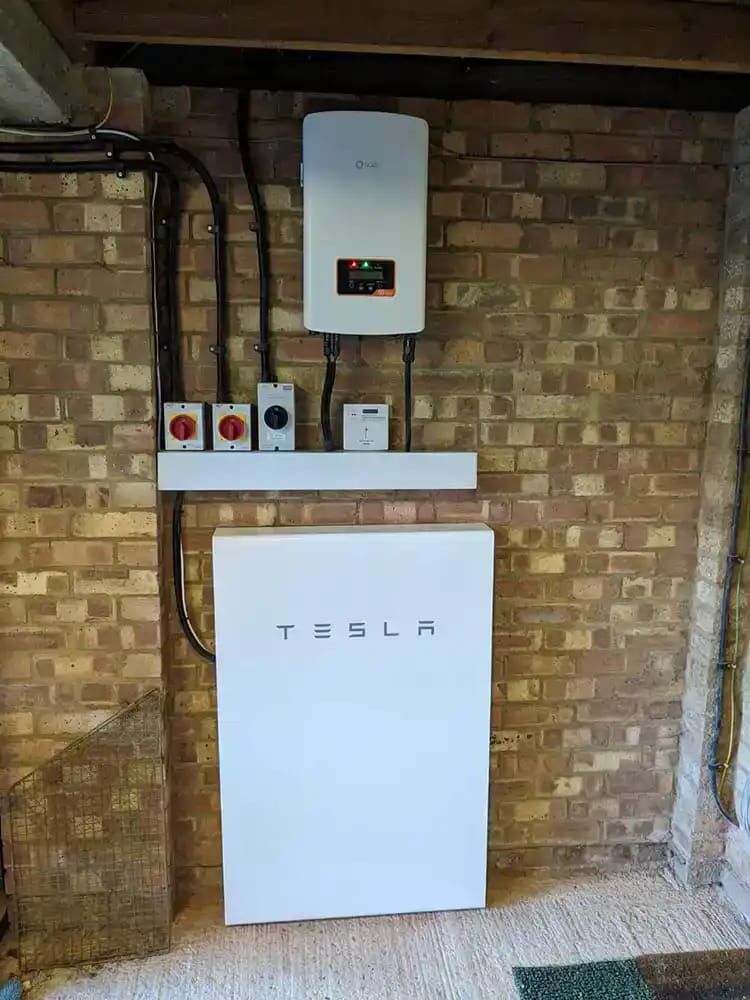
A battery without solar: charge cheap overnight, run the house through the expensive peak
You do not need solar panels to benefit from a home battery. A battery-without-solar system charges from the grid during a cheap overnight window on a smart time-of-use tariff, then powers your house through the expensive teatime peak instead of buying that power at the pricey rate. It is the answer for flats, north-facing roofs, listed buildings, rented-roof situations, or simply anyone who cannot or would rather not fit panels but still wants a lower bill and a degree of control over energy prices.
The mechanism is called arbitrage: buy low, use later, avoid buying high. On a tariff like Octopus Go or Intelligent Octopus Go you charge at around 7p a unit overnight, and on Agile you can catch plunge slots as low as 5 to 8p, occasionally below zero on very windy nights. You then discharge through the 4 to 7pm peak, when grid power costs 28p or more. The bigger the gap between off-peak and peak, the more you save, and the best tariffs in 2026 offer a spread of about 15 to 17p a unit.
Who it suits, and an honest warning
This suits homes that cannot fit solar, and anyone wanting the quickest, lowest-hassle bill saving. But be clear-eyed: the payback lives or dies on the tariff spread. You need a smart meter and a genuine cheap overnight window with a real gap to the peak rate. On a flat single-rate tariff with no cheap slot, a battery-without-solar will not pay back, and we will tell you that up front rather than sell you one. If you have a suitable roof, solar and battery together or a retrofit to existing panels will usually give a better return, because you are then storing free electricity rather than merely cheaper electricity.
How it works
Coupling is less critical here than for a solar setup, because you are charging from the grid either way rather than from panels. The battery has its own inverter, charges in the off-peak window your tariff provides, and discharges to cover your household load through the peak. Because you are trying to carry the whole day's usage outside the cheap window, a battery-without-solar generally needs to be larger than a solar battery, usually 10 kWh or more, sized to a full day's use minus whatever falls inside the off-peak hours.
As always, compare quotes on usable capacity in kWh, not the nominal figure, and check the continuous power rating in kW is high enough to run the house and any heavy loads at once when the battery is carrying the whole home.
Realistic cost and payback
A battery-without-solar system typically costs £5,000 to £10,000 including 0 percent VAT, for a 10 to 16 kWh usable battery, at roughly £500 to £800 per usable kWh installed. Payback usually lands around 8 years, though it can be considerably faster, in the region of 3 to 8 years, for a large battery cycled hard every day on a very cheap tariff like Octopus Go. Realistic savings run about £250 to £550 a year on a strong off-peak tariff, purely from buying the day's power at the right time. Note that a battery-without-solar earns no Smart Export Guarantee income, because there is no solar surplus to export; the whole return comes from the tariff spread.
Getting the size right and choosing the tariff
Size to a full day's household use minus the portion that already falls in the cheap window. A 3,600 kWh a year home often lands on a 10 kWh battery; heavier users step up to 13 to 16 kWh. The tariff is half the decision: you need a genuine off-peak rate and a wide spread to the peak. One caution: Octopus paused new Flux and Intelligent Flux sign-ups in April 2026 amid volatile wholesale prices, so check current tariff availability rather than assuming a specific export or import product will still be open. Our savings calculator lets you test the numbers against your usage.
Key considerations
- Smart meter and tariff: essential. Without a smart meter and a real off-peak-to-peak spread, the case collapses.
- Size up, not down: you are carrying the whole day, so a battery that empties before the peak ends leaves you buying dear anyway.
- DNO notification: G98 for systems up to 3.68 kW per phase, G99 above, handled by your installer.
- Planning: permitted development, no planning permission for almost all homes; flats may need freeholder consent for siting.
- Safety and warranty: LFP only, to BS 7671 and PAS 63100 by an MCS-registered, RECC-backed installer, warranted for around 6,000 to 10,000 cycles or 10 to 12 years. A battery-without-solar cycles hard daily, so a strong throughput warranty matters more than usual.
- Manufacturer stability: because this battery works hard every day, warranty security is critical. GivEnergy entered administration in April 2026, casting doubt over warranty support, firmware and spares for its units, so we would not recommend a new GivEnergy system. We compare independent installers and factor manufacturer stability into every brand steer.
An illustrative example
As an illustrative composite, not a named customer: a couple in a mid-terrace with a north-facing roof unsuitable for solar both worked and used most of their electricity in the evening peak, on about 3,600 kWh a year. They fitted a 10 kWh usable LFP battery, grid-charged with no solar, for around £6,500 including 0 percent VAT, on Octopus Intelligent Go. In the model they charged at roughly 7p overnight and ran the whole household through the 4 to 7pm peak instead of paying 28p or more, saving about £520 a year, a payback near 8.1 years. A smart meter was fitted and the installer filed the G98 notification. The figures are illustrative and depend entirely on your usage and tariff.
Wondering if it stacks up for your home? Run the savings calculator, read the cost guide, or get an honest quote from MCS installers who will tell you straight if a battery is not worth it for you. The FAQs cover the tariff questions in detail, and you can compare a 10 kWh system or a larger 13.5 kWh setup for higher usage.
Typical battery without solar (off-peak tariff arbitrage) install
- Usable capacity
- 3.6-5 kW / 10-16 kWh usable
- Installed cost (0% VAT)
- £5,000-£10,000 (0% VAT)
- Payback
- 8 years
- Annual CO₂ saved
- 0.2-0.5 (grid-mix dependent) tonnes
Get a free battery without solar (off-peak tariff arbitrage) quote
Responds within one working day
- 1. A quick call to understand your home, usage and what you want the battery to do.
- 2. Compared quotes from independent, MCS-registered installers — sized honestly, with a realistic payback.
- 3. Install and aftercare by MCS-certified engineers, 0% VAT applied.
- MCS Certified
- NICEIC
- RECC
- TrustMark
Common questions
How much does home battery storage cost in the UK in 2026?
Most UK homeowners pay between roughly £2,500 and £11,000 for a fully installed home battery, depending on size and brand. As a rule of thumb it works out at around £500-£800 per usable kWh installed. A 5 kWh system is typically £3,500-£5,500; a 10 kWh system (the most common size) £5,000-£8,500; and a 13.5 kWh Tesla Powerwall 3 around £8,000-£11,500 installed. All of these attract 0% VAT until 31 March 2027. Battery-only retrofits to existing solar are cheaper because there's no roof work. The best way to know your figure is a quote against your actual usage.
Is a home battery worth it without solar panels?
It can be, but only with the right tariff. On a smart time-of-use tariff like Octopus Go or Intelligent Octopus Go you charge the battery overnight at around 7p/kWh (or lower on Agile plunge slots) and run the house through the 4-7pm peak instead of paying 28p+. On a 10 kWh battery cycling once a day that's roughly £250-£550 a year of saving, purely from buying power at the right time. You need a smart meter and a real gap between off-peak and peak rates. On a flat single-rate tariff with no cheap window, a battery-without-solar won't pay back.
What size home battery do I need?
Size it to what you can fully cycle once a day, based on your annual usage (on your electricity bill). As a guide: under ~2,800 kWh/yr suits about 5 kWh; a typical 3,000-4,500 kWh/yr home suits around 10 kWh (the sweet spot most households choose); high-usage homes, EV owners, heat-pump homes or those wanting whole-home backup move to 13.5 kWh or more. A battery that's too big never fully empties, so you've paid for capacity that never earns its keep. Bigger isn't better - right-sized is.
Tesla Powerwall vs GivEnergy vs Fox ESS - which home battery is best?
There's no single best - it depends on budget, whether you want whole-home backup, and how you weigh warranty security. Tesla Powerwall 3 (13.5 kWh usable, 100% depth of discharge, integrated backup gateway, stackable) is the premium pick and excellent for backup. Fox ESS and Sunsynk offer strong value per kWh for a solar-and-battery setup, and modular brands let you add capacity later. Be aware GivEnergy entered administration in April 2026, so we factor manufacturer stability into every recommendation. Because we compare independent MCS installers, you get an honest steer, not a single tied brand.
Can I charge a home battery from a cheap night-time tariff?
Yes - this is the core of a battery-without-solar setup and a big bonus even with solar. Smart time-of-use tariffs give you a cheap overnight window: Octopus Go/Intelligent Octopus Go is around 7p/kWh for a fixed six hours, and Agile can drop to 5-8p/kWh (occasionally below zero on very windy days). You charge the battery in that window and discharge it through the expensive 4-7pm peak. The bigger the gap between off-peak and peak, the more you save - the best tariffs offer a 15-17p/kWh spread in 2026. You need a smart meter to access these tariffs.
Is there 0% VAT on home battery storage?
Yes. Since 1 February 2024, domestic battery storage in Great Britain attracts 0% VAT - including a battery added to solar, a retrofit to existing solar, and a standalone battery fitted without any solar at all. The relief runs until 31 March 2027, after which it reverts to 5%. That's a straight 20% saving on the supply-and-install price versus the old standard rate, which is one of the strongest reasons to install before the deadline.