Tesla's UK list price for one Powerwall 3 is £5,000 without the Backup Gateway 2 and £5,975 with it, excluding VAT, delivery and installation. Octopus lists a battery-only Powerwall 3 installation from £7,999 at April 2026 prices, and EDF prices one from £7,995. At £7,999 that is about £593 per kWh, close to the official median of £630 per kWh for batteries of 11 kWh or more. Installed home batteries are zero-rated for VAT until 31 March 2027.
Tesla list price £5,000 without Backup Gateway 2, £5,975 with it (excluding VAT, delivery and installation). Installed battery-only from £7,999 (Octopus, April 2026 prices).
10 years from installation with 80% of energy retained. Unlimited cycles for solar self-consumption, time-based control and backup; other uses capped at 37.8 MWh. Must be bought from Tesla or a certified installer, and the full term needs an internet connection (at least 4 years otherwise).
| Specification | Published figure |
|---|---|
| Usable energy | 13.5 kWh (AC, minimum at beginning of life) |
| Power output | Configurable from 3.68 kW to 11.04 kW at 230 V (16 A to 48 A continuous) |
| Maximum charge rate | 5 kW alone; 8 kW with Expansion units |
| Built-in solar inverter | 3 MPPTs, up to 20 kW of solar at STC, 60 V to 550 V DC input |
| Efficiency (Tesla figures) | 97.5% solar to home or grid; 89% solar to battery to home or grid |
| Size and weight | 1,105 × 609 × 193 mm, 130 kg; floor or wall mount |
| Weather rating | IP55 enclosure (battery and power electronics IP67); indoor or outdoor |
| Operating temperature | −20°C to 50°C; may be de-rated above 40°C |
| Noise at 1 m | Under 50 dB(A) typical, under 62 dB(A) maximum |
| Backup | Needs Backup Gateway 2; non-backup installs use a Tesla Remote Meter instead |
| Largest system | Up to 4 Powerwall 3 and 3 Expansion units: 94.5 kWh and 44 kW |
| Grid codes listed | G98, G99, G100 and the Northern Ireland G98/NI and G99/NI |
What a Powerwall 3 costs in the UK
Tesla publishes UK list prices, but they are not what you pay: the page says they exclude VAT, delivery, installation and other costs, and that the final price comes from a Tesla Certified Installer. The installed prices below are the ones suppliers and installers publish.
| Configuration | Price | Who publishes it |
|---|---|---|
| 1 Powerwall 3, no Gateway (non-backup) | £5,000 list, excluding installation | Tesla UK quote page |
| 1 Powerwall 3 with Backup Gateway 2 | £5,975 list, excluding installation | Tesla UK quote page |
| 1 Powerwall 3 and 1 Expansion unit (27 kWh), no Gateway | £9,000 list | Tesla UK quote page |
| 1 Powerwall 3 and 1 Expansion unit, with Gateway | £9,975 list | Tesla UK quote page |
| Powerwall 3, battery-only, installed | from £7,999 | Octopus (April 2026 prices) |
| Powerwall 3 battery, installed, from E.ON Next | from £7,795 | E.ON Next (read 6 October 2026) |
| Powerwall 3 battery (installation not itemised) | from £7,995 | EDF |
| Powerwall 3 retrofit installation by Fresh Solar | £8,499.99 | Costco UK (read 7 October 2026) |
| Powerwall 3 with Gateway, installed, no solar | about £8,000 | Glow Green |
| 2 or 3 Powerwall 3 with Gateway, installed | about £15,000 or £22,000 | Glow Green |
| Expansion Pack fitted with a new Powerwall 3 | £3,773 | Octopus |
| Expansion Pack added to an existing Powerwall 3 | £5,909 | Octopus (its own installations only) |
Read against each other, Tesla’s list prices put the Backup Gateway 2 at £975 and one Expansion unit at £4,000. At £7,999 installed, a Powerwall 3 works out at about £593 per kWh, a little below the official median of £630 per kWh for MCS-certified batteries of 11 kWh or more fitted in 2025/26. Octopus’s pricing also shows why capacity is cheapest when it goes in on day one: the same Expansion Pack costs £3,773 at installation and £5,909 added later. Its Tesla solar package, the other batteries it fits and the deposit it takes are compared in our guide to Octopus’s home batteries.
Four published installed prices, £705 apart
| Supplier | Installed price | Per usable kWh | What its page says |
|---|---|---|---|
| E.ON Next | from £7,795 | about £577 | A Powerwall 3 with a 10-year manufacturer warranty; a full survey decides where it goes |
| EDF | from £7,995 | about £592 | Fitted by Contact Solar, a Which? Trusted Trader; the price includes an inverter |
| Octopus | £7,999 | about £593 | Battery-only installation at April 2026 prices; a £500 non-refundable deposit at signing |
| Costco UK, installed by Fresh Solar | £8,499.99 | about £630 | A retrofit installation; delivery included in Zone 1; any grid connection charge falls to the customer |
Prices are from the suppliers’ own pages, read on 6 and 7 October 2026 (Octopus’s are April 2026 prices). The official median for MCS-certified batteries of 11 kWh or more fitted in 2025/26 was £630 per kWh, so Costco’s price sits on it and the other three about 6 to 8% below it.
The gap between cheapest and dearest is £705, about 9%, which is small enough that what is included matters more than the headline. Costco’s page says a grid application or connection offer may be charged to the customer and confirmed when the installation is booked, that the contract is with the installer rather than Costco, and that Costco’s returns policy does not apply to installed goods, though legal rights are unaffected. Octopus’s deposit is non-refundable once you sign. For solar and a Powerwall together, Octopus’s FuturePower package is listed from £12,362 and Good Energy lists 10 panels with a Powerwall 3 and power-cut protection from £13,900.
What the list price leaves out
- VAT. Installed batteries in homes are zero-rated until 31 March 2027 under HMRC’s VAT Notice 708/6, and the relief covers installation. A battery sold without installation carries the standard rate.
- The Gateway or Remote Meter. A non-backup Powerwall 3 needs a Tesla Remote Meter, which Tesla says is not included in the £5,000.
- Installation. Tesla says a typical Powerwall installation takes a full day, with the power off for about four to six hours, or eight or more if extra electrical work is needed.
- Network approval. Powerwall 3 can be set anywhere from 3.68 kW to 11.04 kW. Above the G98 limit of 16 A per phase, about 3.68 kW on a single-phase home counting every inverter, the installer must apply to the network under G99 before connecting.
The solar battery cost guide sets the four installed prices beside the official medians for every size and the average installation in each band.
Backup or no backup
The £975 difference in Tesla’s list prices is the choice between a battery that keeps the lights on and one that does not.
- With Backup Gateway 2, Powerwall 3 isolates the home from the grid in a cut and keeps it running, with Tesla’s Backup Reserve, Storm Watch and Go Off-Grid features.
- Without it, a Tesla Remote Meter takes the Gateway’s place and the battery gives no backup power. If solar panels are wired directly to the Powerwall, it keeps charging from them during a power cut but does not power the home.
A Gateway can be added later to upgrade a non-backup system. If backup matters to you, ask each installer to price it both ways. Our page on home battery backup explains what a backup circuit can and cannot run.
The specifications that matter in a UK home
Charging speed against the cheap window. Powerwall 3 charges at up to 5 kW on its own, so filling 13.5 kWh from empty takes roughly 2 hours 45 minutes before losses. That fits inside the three-hour cheap window on Octopus Flux (2am to 5am). With one Expansion unit, 27 kWh at up to 8 kW takes about 3 hours 20 minutes, slightly longer than the window.
A solar inverter built in. Powerwall 3 has three solar inputs and accepts up to 20 kW of panels, so a new solar and battery system needs no separate solar inverter. Tesla positions it for new solar-plus-storage installations, though it says Powerwall 3 can also be added to existing solar and works with all major inverter brands. See AC vs DC coupled batteries for what that choice means.
Weight and where it can go. At 130 kg it needs a solid floor or wall, and Tesla limits the bottom of a wall-mounted unit to 1,140 mm off the ground. It is rated IP55 for outdoor use, which matters because PAS 63100, the fire-safety specification for batteries in homes, prefers outdoor locations and rules out bedrooms, escape routes and lofts. See PAS 63100 explained.
The largest system is larger than a home may hold. Tesla’s datasheet allows up to four Powerwall 3 units and three Expansion units, 94.5 kWh. For homes within its scope, PAS 63100 caps total storage at 80 kWh outdoors, in a garage or in an outbuilding, and 40 kWh elsewhere, so the top configuration goes beyond what the specification allows in a single dwelling.
The warranty in plain English
The UK warranty (Rev. 1.16, effective 3 December 2025) is given by Tesla Motors Netherlands B.V. and runs for 10 years from installation, with 80% of the 13.5 kWh retained at year 10. The conditions matter more than the headline:
- Unlimited cycles, for three uses. Solar self-consumption, time-based control (storing grid or solar energy for time-of-use shifting) and backup have no throughput limit. Other uses, such as trading or grid services, or any mix that includes them, are capped at 37.8 MWh, about 2,800 full cycles.
- Bought and installed the right way. Cover applies only to units bought from Tesla or a certified installer in the European warranty region and installed there. Faults from installation, modification or repair by anyone else are excluded, as is moving the unit to another address without Tesla’s written consent.
- Kept online. If the Powerwall is offline for long periods or not registered, Tesla may not honour the full 10 years, but it will always honour at least 4.
- Transferable. A later owner can claim with proof of ownership. For a UK house sale, Tesla asks for a copy of the Transfer Deed and photos of the stickers on the Gateway or Remote Meter and every Powerwall.
- Claims go through the installer. Tesla chooses whether to repair, replace or refund the market price, and you start a claim with the certified installer who sold the system.
What a Powerwall 3 saves and how long it takes to pay back
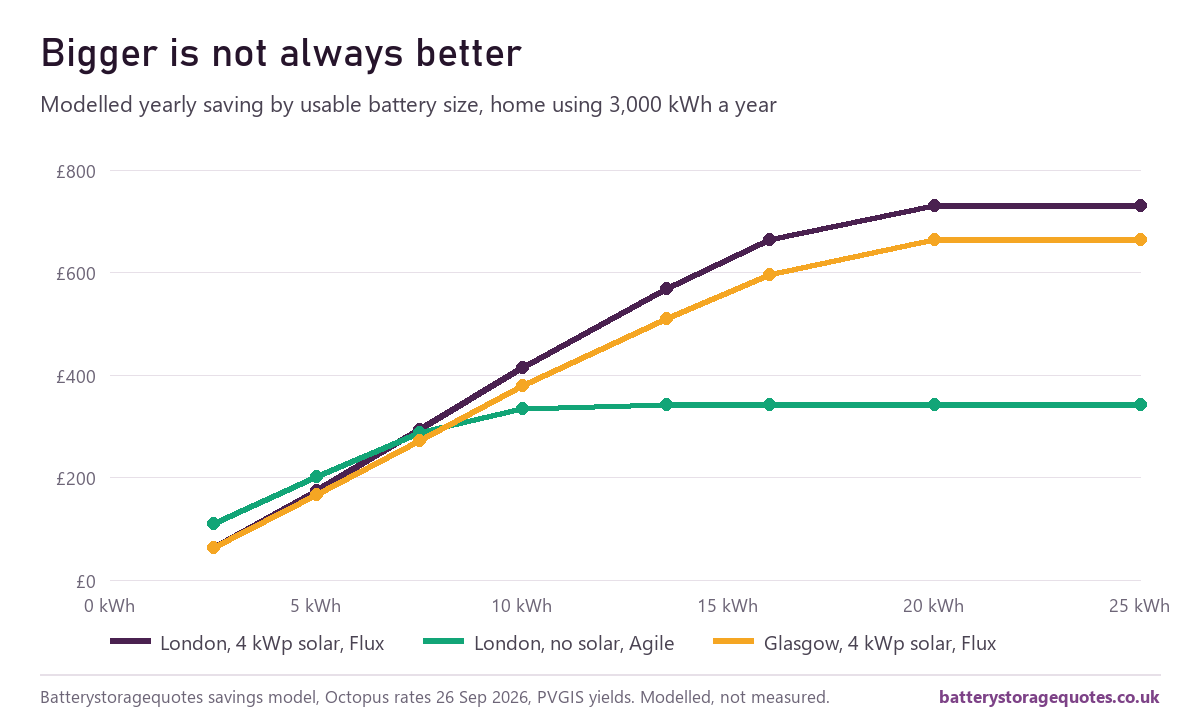
In this site’s model, a home using 3,000 kWh a year with 4 kWp of solar on Octopus Flux saves between £511 a year (South Scotland) and £623 (Merseyside and North Wales) with a 13.5 kWh battery, and £569 in London. Against Octopus’s £7,999 that is a simple payback of 12.8 to 15.7 years, 14.1 in London. At the official median of about £8,505 for 13.5 kWh it is 13.7 to 16.7 years. Both ignore the battery losing capacity over time. The model counts only the battery’s bill saving: it puts no value on the built-in solar inverter or on backup in a power cut, which are the reasons many buyers pay for a Powerwall. The saving for every one of the 14 electricity regions is in our article on Powerwall 3 payback by region.
Is a second Powerwall worth it?
A second unit takes the system to 27 kWh and adds less than the first, because a typical home cannot empty it every day:
| Home (London, Octopus Flux) | Saving with 13.5 kWh | With 27 kWh | Added by the second unit | Payback of the second unit at £3,773 or £5,909 |
|---|---|---|---|---|
| 3,000 kWh a year, 4 kWp of solar | £569 | £731 | £162 | 23 years or 36 years |
| 3,000 kWh a year, 6 kWp of solar | £575 | £771 | £196 | 19 years or 30 years |
| 6,000 kWh a year, 6 kWp of solar | £524 | £931 | £406 | 9 years or 14.5 years |
The two prices are Octopus’s, for an Expansion Pack fitted with a new Powerwall 3 and for one added to an existing unit later. An average home gains little from the second unit, which is the case for fitting a single battery of the right size instead; a home with a heat pump or an electric car is the exception. Ask for the price both ways before you decide, because adding capacity later costs more.
Tariffs for a Powerwall
The Tesla Energy Plan tariff has been retired in the UK, and Octopus names Flux as its successor. Octopus Flux needs solar panels, a home battery, a smart meter, an export MPAN and the MCS certificate, and its rates for every region are on the Octopus Flux rates page. Intelligent Octopus Flux can control a Powerwall directly, with the reserve fixed at 20%, but Octopus currently limits it to customers who bought solar panels and a battery from Octopus. Without solar, an overnight tariff or Agile Octopus is the usual route; see the best tariff for a home battery.
Who a Powerwall 3 suits
It suits homes fitting new solar and a battery together, homes with high evening use, an electric car or a heat pump, and anyone who wants whole-home backup. In this site’s model, a London home using 3,000 kWh a year with 4 kWp of solar on Flux saves about £569 a year with 13.5 kWh against £414 with 10 kWh, so the extra capacity pays only if the home can use it. For a smaller home, a 5 or 10 kWh battery may capture most of the saving for less; see 13.5kWh batteries and the calculator.
How long a full battery lasts at each load, from 250 W to the 11.04 kW maximum, is in how long a 13.5kWh battery lasts.
How to check a Powerwall 3 quote
- Confirm the installer is certified. Tesla’s UK Certified Installer finder lists them by postcode, and some carry a Premium Installer badge.
- Ask whether the Gateway is included, or whether it is a non-backup system with a Remote Meter.
- Ask for the output setting and the network route: G98 notification or a G99 application, and any export limit.
- Check the location against PAS 63100 and ask for the statement of conformity with the electrical certificate.
- Price any Expansion unit now if you think you will want one; later it may cost more.
Then compare two or three battery storage quotes line by line, including one for a different brand. The Fox ESS and Enphase pages cover the most common alternatives Octopus and other large installers offer.
Questions people ask
How much is a Tesla Powerwall 3 in the UK?
Tesla's UK quote page lists £5,000 for one Powerwall 3 without the Backup Gateway 2 and £5,975 with it, excluding VAT, delivery and installation. Octopus lists a battery-only installation from £7,999 (April 2026 prices) and EDF prices one from £7,995. Installers set the final price, so compare more than one quote.
Can I buy a Powerwall 3 directly from Tesla in the UK?
No. Tesla's UK quote form passes your details to a local Tesla Certified Installer, who confirms the price and installs it. The warranty only applies to a Powerwall bought from Tesla or a certified installer and installed in the European warranty region, which includes the UK.
Do I need the Backup Gateway 2?
Only if you want power in a power cut. A non-backup installation uses a Tesla Remote Meter instead and gives no backup power; the Gateway adds £975 at Tesla's list prices. You can add a Gateway later to upgrade to backup.
Can a Powerwall 3 be added to existing solar panels?
Yes. Tesla says Powerwall 3 can be added to existing solar systems and works with all major inverter brands, although it is designed around its own built-in solar inverter for new installations. Adding it to existing solar may need a G99 application if the combined inverter output exceeds the G98 limit.
How long is the Powerwall 3 warranty?
Ten years from installation, with 80% of the 13.5 kWh retained at the end in the UK. Cycles are unlimited for solar self-consumption, time-of-use shifting and backup. Tesla only guarantees the full ten years if the battery stays connected to the internet; otherwise it honours at least four.
Which UK supplier has the cheapest installed Powerwall 3?
Of four published installed prices read in October 2026, E.ON Next's from £7,795 is the lowest, then EDF from £7,995, Octopus at £7,999 (April 2026 prices) and Fresh Solar through Costco UK at £8,499.99. Each is a standard or from price that a survey can change, so compare what is included: the Backup Gateway, the network application and who holds the warranty paperwork.
Is a Tesla Powerwall 3 worth the price?
On the battery's bill saving alone it takes about 13 to 16 years. In this site's model a home using 3,000 kWh a year with 4 kWp of solar on Octopus Flux saves between £511 and £623 a year with 13.5 kWh depending on region, which repays a £7,999 installation in 12.8 to 15.7 years. The model puts no value on the built-in solar inverter or on backup in a power cut, which are the reasons many buyers choose it.
Is a second Powerwall or an Expansion Pack worth it?
Rarely for an average home. A second 13.5 kWh unit adds about £162 a year in a London home using 3,000 kWh with 4 kWp of solar on Flux, a payback of 23 years at Octopus's £3,773 for a pack fitted with the first Powerwall and 36 years at the £5,909 it charges to add one later. For a 6,000 kWh home with 6 kWp of solar the second unit adds about £406 a year, which pays back in 9 years at £3,773.
How many Powerwall 3 batteries can I install?
Tesla's datasheet allows up to four Powerwall 3 units and up to three Expansion units, 94.5 kWh in total. In a home, the fire-safety specification PAS 63100 caps total storage at 80 kWh outdoors or in a garage and 40 kWh elsewhere, so the practical ceiling is lower.