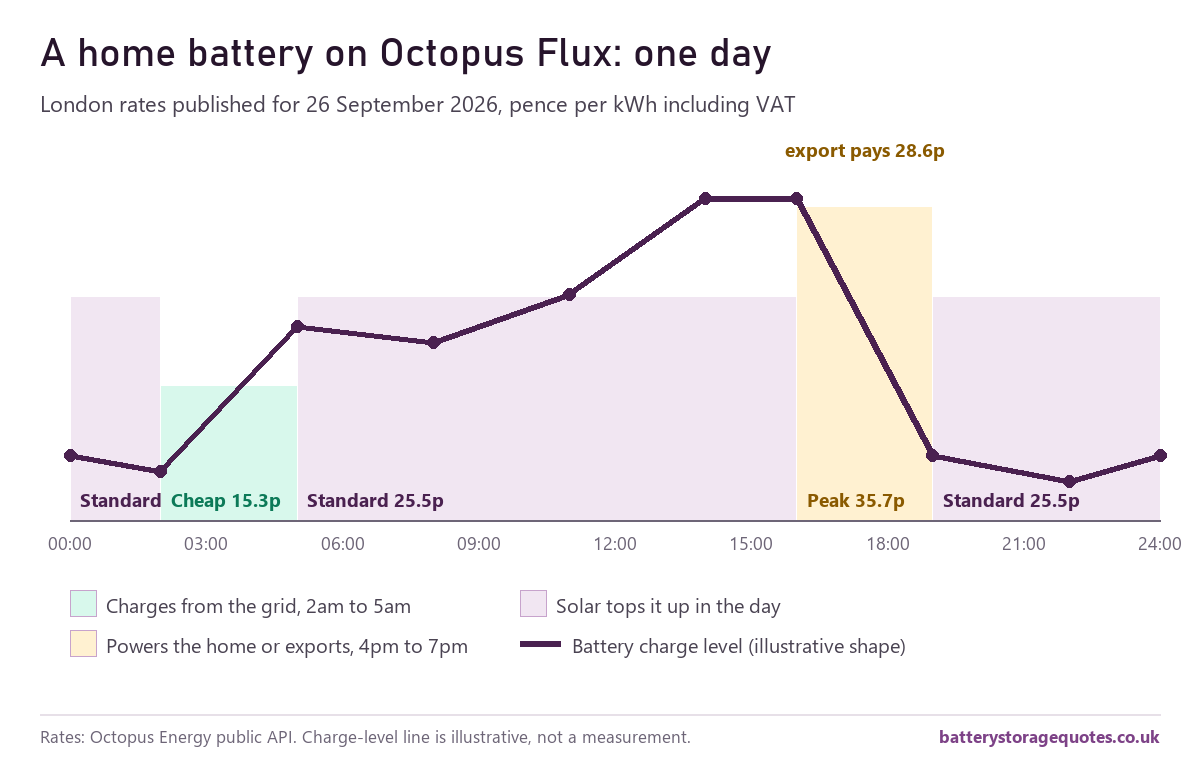
On 28 October 2026 standard Octopus Flux import costs 15.41p to 16.94p per kWh from 2am to 5am, 25.53p to 28.05p for the rest of the day and 35.64p to 39.16p from 4pm to 7pm, depending on region, and export pays 28.90p to 31.75p in the 4pm to 7pm peak. Import rates carry no VAT since 1 October and rose by about 10% on 19 October. The daily standing charge runs from 42.29p (London) to 66.74p and also rose on 19 October, by 2.7% to 4.8%. Flux needs solar panels, a home battery, a smart meter and an Octopus export tariff. Intelligent Octopus Flux was marked unavailable on Octopus's own page on 7 and 28 October.
Octopus Flux import rates in every region
Standard Octopus Flux has three price periods in a day. The table lists what Octopus published for each of the 14 distribution regions on 28 October 2026 (pence per kWh, direct debit, no VAT on household electricity since 1 October, rates as raised on 19 October). The region code is the letter Octopus uses in its tariff codes.
| Region | Code | 2am to 5am | Standard | 4pm to 7pm | Standing charge a day |
|---|---|---|---|---|---|
| London | C | 16.17p | 26.78p | 37.38p | 42.29p |
| South East England | J | 16.34p | 27.06p | 37.78p | 52.21p |
| Southern England | H | 16.09p | 26.65p | 37.20p | 47.47p |
| South West England | L | 16.16p | 26.76p | 37.37p | 55.52p |
| Eastern England | A | 16.18p | 26.79p | 37.41p | 51.67p |
| East Midlands | B | 15.41p | 25.53p | 35.64p | 50.75p |
| West Midlands | E | 15.56p | 25.78p | 35.99p | 56.61p |
| Yorkshire | M | 15.56p | 25.78p | 35.99p | 60.86p |
| North East England | F | 15.47p | 25.63p | 35.78p | 60.70p |
| North West England | G | 16.10p | 26.67p | 37.23p | 44.85p |
| Merseyside and North Wales | D | 16.94p | 28.05p | 39.16p | 66.74p |
| South Wales | K | 16.14p | 26.73p | 37.33p | 54.36p |
| South Scotland | N | 15.87p | 26.28p | 36.70p | 61.44p |
| North Scotland | P | 16.01p | 26.52p | 37.03p | 55.28p |
The three import rates keep exactly the same proportions in every region: the cheap period is 60% of the standard rate and the peak is 140% of it. The periods are fixed in UK local time all year round: 02:00 to 05:00 and 16:00 to 19:00, according to Octopus. Octopus’s public data stamps them in UTC, so they shifted by an hour when the clocks changed on 25 October. The South Scotland (N) and North Scotland (P) rows feed the modelled savings in what these rates mean for a battery in Scotland, and the Merseyside and North Wales (D) and South Wales (K) rows feed battery savings across North and South Wales.
Octopus Flux export rates by region
Export is what makes Flux a battery tariff. The 4pm to 7pm rate is 2.7 times the standard export rate in every region, and the standard rate itself (10.60p to 11.64p) sits below Outgoing Octopus’s flat 12p. In other words, Flux pays less than Outgoing for exports outside the peak and far more inside it.
| Region | 2am to 5am | Standard | 4pm to 7pm |
|---|---|---|---|
| London | 4.72p | 11.11p | 30.31p |
| South East England | 4.77p | 11.23p | 30.64p |
| Southern England | 4.70p | 11.06p | 30.16p |
| South West England | 4.72p | 11.11p | 30.30p |
| Eastern England | 4.72p | 11.12p | 30.33p |
| East Midlands | 4.50p | 10.60p | 28.90p |
| West Midlands | 4.54p | 10.70p | 29.18p |
| Yorkshire | 4.54p | 10.70p | 29.18p |
| North East England | 4.52p | 10.64p | 29.01p |
| North West England | 4.70p | 11.07p | 30.19p |
| Merseyside and North Wales | 4.94p | 11.64p | 31.75p |
| South Wales | 4.71p | 11.10p | 30.26p |
| South Scotland | 4.63p | 10.91p | 29.75p |
| North Scotland | 4.67p | 11.01p | 30.03p |
Export rates never carried VAT, so the 1 October change did not touch them. Octopus puts no cap on the export rate or on how much you export in a month. The real ceiling is the export limit your installation was approved for, which is a G98 or G99 matter.
Flux export is one of five Octopus export tariffs. The Octopus export tariff comparison sets it beside Outgoing Octopus at 12p, Prime Outgoing at 16p and 9p, Agile Outgoing and the 4.1p Smart Export Guarantee tariff, with 12 months of Agile Outgoing prices by region.
What changed on 1 October and on 19 October
Excluding VAT, every Flux import, Flux export and Intelligent Flux import rate in the 14 regions was the same on 7 October as on 26 September 2026, to within rounding (under a thousandth of a penny). The fall in the import prices on this page is entirely the removal of the 5% VAT on household electricity, which cut the headline price by 4.8%: London’s standard rate was 25.47p on 26 September and 24.25p from 1 October.
On 19 October the unit rates themselves went up. In London the cheap import rate rose 11.0% (14.56p to 16.17p), the standard rate 10.4% (24.25p to 26.78p) and the 4pm to 7pm rate 10.1% (33.96p to 37.38p). Across the 14 regions the rises were 9.5% to 11.6%, 8.8% to 10.9% and 8.5% to 10.6%. Export moved less evenly: in London the cheap export rate fell 10.0% (5.24p to 4.72p), the standard rate rose 13.4% (9.80p to 11.11p) and the peak rate rose 6.0% (28.60p to 30.31p). Octopus’s public data shows the new rates from 19 October, and we have not found a reason stated by Octopus. The daily standing charge also rose on 19 October in all 14 regions, as the public data had shown in advance:
| Region | Flux standing charge to 18 October | From 19 October | Change | Flexible Octopus standing charge |
|---|---|---|---|---|
| London | 40.40p | 42.29p | +4.7% | 41.39p |
| South East England | 50.24p | 52.21p | +3.9% | 51.05p |
| Southern England | 45.44p | 47.47p | +4.5% | 46.30p |
| South West England | 53.65p | 55.52p | +3.5% | 54.49p |
| Eastern England | 49.71p | 51.67p | +4.0% | 50.55p |
| East Midlands | 48.63p | 50.75p | +4.4% | 50.20p |
| West Midlands | 54.62p | 56.61p | +3.7% | 56.27p |
| Yorkshire | 58.80p | 60.86p | +3.5% | 60.89p |
| North East England | 58.59p | 60.70p | +3.6% | 60.80p |
| North West England | 42.79p | 44.85p | +4.8% | 44.21p |
| Merseyside and North Wales | 64.76p | 66.74p | +3.1% | 67.27p |
| South Wales | 52.25p | 54.36p | +4.0% | 54.44p |
| South Scotland | 59.84p | 61.44p | +2.7% | 60.69p |
| North Scotland | 53.61p | 55.28p | +3.1% | 54.15p |
Before 19 October the Flux standing charge was below Flexible Octopus’s in all 14 regions. Since then it has been above it in 10 of the 14, against Flexible Octopus’s published charge on 28 October. The rise is 1.6p to 2.1p a day, which is £5.86 to £7.72 over a year depending on region. That is small next to the unit-rate spread, but it is a cost a home pays whether or not the battery is working. Octopus’s page says Flux is a flexible tariff: its rates rise and fall with wholesale prices, it gives reasonable notice of changes and there are no exit fees.
Flux against Flexible Octopus: what a home pays for the same kWh
Flux is now cheaper than the standard variable tariff only in the cheap period; since 19 October the standard rate is about the same as Flexible Octopus’s and the peak is dearer. In London on 28 October, Flexible Octopus cost 26.60p per kWh all day:
| London, 28 October 2026 | Flux import | Against Flexible Octopus at 26.60p |
|---|---|---|
| 2am to 5am | 16.17p | 39.2% lower |
| Standard | 26.78p | 0.7% higher |
| 4pm to 7pm | 37.38p | 40.6% higher |
The consequence is the main trap of the tariff. A home that cannot keep the battery doing its job between 4pm and 7pm pays 40.6% more than on Flexible Octopus for every kWh it draws from the grid in those three hours. That is why standard Flux asks you to schedule the battery yourself, and why a battery that is too small to cover the peak can leave a Flux home worse off than a flat tariff. In this site’s model (London, 3,000 kWh a year, Octopus’s 26 September rates, which were lower than today’s), a 6 kWp array with a 5 kWh battery saves £143 a year on Flux against £199 on a flat tariff, while with a 10 kWh battery the figures are £401 and £211. The tariff rewards a battery big enough to cover the peak and export a surplus.
What the gap between the rates is worth to a battery
A battery earns on Flux in two ways: it covers the home’s own peak-time use with energy bought at the cheap rate, and it exports what is left at the peak export rate. The cleanest way to compare regions is the margin on one kWh that goes in cheaply and comes out at the peak export rate, after the losses on the round trip. This site’s model assumes 90% round-trip efficiency, so a kWh delivered costs 1 / 0.9 kWh bought.
| Region | Peak export minus cheap import | Margin per kWh cycled at 90% efficiency | 10 kWh a day for a year, upper limit |
|---|---|---|---|
| London | 14.15p | 12.35p | £451 |
| South East England | 14.30p | 12.48p | £456 |
| Southern England | 14.08p | 12.29p | £449 |
| South West England | 14.14p | 12.34p | £451 |
| Eastern England | 14.15p | 12.36p | £451 |
| East Midlands | 13.49p | 11.77p | £430 |
| West Midlands | 13.62p | 11.89p | £434 |
| Yorkshire | 13.62p | 11.89p | £434 |
| North East England | 13.54p | 11.82p | £431 |
| North West England | 14.09p | 12.30p | £449 |
| Merseyside and North Wales | 14.82p | 12.94p | £472 |
| South Wales | 14.12p | 12.33p | £450 |
| South Scotland | 13.88p | 12.12p | £442 |
| North Scotland | 14.01p | 12.23p | £447 |
Read the last column as an upper limit, not a forecast. It assumes a 10 kWh battery is filled from the grid at 2am to 5am and emptied into the grid from 4pm to 7pm every day of the year, ignores the standing charge, ignores the home’s own use and the battery’s fade, and needs an export limit of at least 3.3 kW. Merseyside and North Wales has the widest gap and East Midlands the narrowest, a difference of £42 a year on that 10 kWh example. The full savings model, which also lets solar fill the battery and the home use some of it, gives lower figures for a typical home: for 3,000 kWh a year, a 10 kWh battery and 4 kWp of solar in London it is £414 a year on Flux against £174 on a flat tariff (Octopus’s 26 September rates; the model has not yet been re-run on the rates in force since 19 October, which are higher on import and different on export). Powerwall 3 payback by region shows how closely the regional pattern follows the peak export rate.
| London, 4 kWp solar, 3,000 kWh a year | Modelled saving on Flux | On a flat tariff |
|---|---|---|
| 5 kWh battery | £174 | £169 |
| 10 kWh battery | £414 | £174 |
| 13.5 kWh battery | £569 | £174 |
| 20 kWh battery | £731 | £174 |
On a flat tariff a battery only stores the surplus solar the home would otherwise export at 12p, so more capacity adds almost nothing past about 5 kWh. Flux is what gives the larger sizes something to do, which is the reason the tariff and the battery size should be chosen together. The price side of the same decision is in the solar battery cost guide, and the solar panels and battery cost guide has the prices if you still have to buy the panels as well. The best tariff for a home battery guide compares Flux with Agile, Go and Cosy.
Who can join Octopus Flux
From Octopus’s Flux page, read on 7 October 2026, you need:
- A solar system and a home battery. They do not have to have been installed by Octopus, and Octopus says the tariff works with all solar and battery systems. If they are being installed, it can start the switch.
- A smart meter that gives half-hourly readings. A second-generation (SMETS2) meter, or a first-generation meter made by Secure.
- An import and an export tariff, both with Octopus. If you are not an Octopus customer, you switch first to Flexible Octopus and Outgoing Octopus, then return to join Flux.
- An export MPAN. Octopus can apply for one for you.
- The MCS document for your installation, before it will complete the switch. A solar system without an MCS certificate is a problem for Flux, and the Smart Export Guarantee asks for an MCS certificate or an equivalent scheme for solar up to 50 kW.
There is no exit fee and no tie-in, so you can leave at any time. Octopus is the only supplier whose rates are listed here because it publishes every regional rate through a public API, which makes a like-for-like table possible; it is not an endorsement, and other suppliers sell time-of-use and export tariffs too. Octopus also sells batteries, with its own prices on the Octopus home battery page.
A home with a battery and no solar cannot join; the home battery without solar page covers the tariffs it can use.
If you are still deciding whether to fit panels and a battery at the same time, solar battery storage covers what a combined system shares and what it costs.
Standard Flux or Intelligent Octopus Flux
Standard Flux leaves the battery schedule to you: Octopus recommends charging from 2am to 5am and discharging from 4pm to 7pm. Intelligent Octopus Flux lets Octopus control a compatible battery, charging when the grid is greenest and exporting at the peak. Its import rates sit between the cheap and standard Flux rates for most of the day:
| Region | Intelligent Flux import | Intelligent Flux 4pm to 7pm | Standard Flux, standard rate | Standard Flux, 4pm to 7pm |
|---|---|---|---|---|
| London | 24.25p | 30.31p | 26.78p | 37.38p |
| South East England | 24.51p | 30.64p | 27.06p | 37.78p |
| Southern England | 24.13p | 30.16p | 26.65p | 37.20p |
| South West England | 24.24p | 30.30p | 26.76p | 37.37p |
| Eastern England | 24.27p | 30.33p | 26.79p | 37.41p |
| East Midlands | 23.12p | 28.90p | 25.53p | 35.64p |
| West Midlands | 23.34p | 29.18p | 25.78p | 35.99p |
| Yorkshire | 23.34p | 29.18p | 25.78p | 35.99p |
| North East England | 23.21p | 29.01p | 25.63p | 35.78p |
| North West England | 24.15p | 30.19p | 26.67p | 37.23p |
| Merseyside and North Wales | 25.40p | 31.75p | 28.05p | 39.16p |
| South Wales | 24.21p | 30.26p | 26.73p | 37.33p |
| South Scotland | 23.80p | 29.75p | 26.28p | 36.70p |
| North Scotland | 24.02p | 30.03p | 26.52p | 37.03p |
Among the products Octopus’s public API lists as available on 7 October there is an Intelligent Flux import tariff but no separate Intelligent Flux export tariff, so this page does not quote an Intelligent Flux export rate. On 7 October 2026 Octopus’s Intelligent Flux page carried two notices: that the tariff was temporarily unavailable because energy prices were volatile, and that it was exclusive to customers who bought solar panels and a battery from Octopus. It also said its compatibility check could not guarantee a match, and listed these battery brands in its selector: AlphaESS, EcoFlow, Enphase, Fox ESS, GivEnergy, Hanchu ESS, Huawei, Sigenergy, SolarEdge and SunPower. Check the page before you buy a battery on the strength of this tariff.
Flux if you already have solar on the Feed-in Tariff
Octopus’s Flux page answers the question that holds back many owners of older panels. You do not have to move your FiT generation contract to Octopus, and the generation payments carry on. What you give up is deemed export: moving to Flux means permanently opting out of the deemed export payments, and being paid the Flux export rate for the units your smart meter measures going out. If you leave Octopus or Flux later, the export side is paid at the Smart Export Guarantee rate of your new tariff or supplier, not the old deemed rate. The wider rules on adding a battery to a Feed-in Tariff installation, which come from Ofgem, are set out in will a battery affect my Feed-in Tariff, and the practical side of adding a battery to existing solar covers the inverter, the network notification and the cost.
Where these numbers come from
Every figure in the tables was read from Octopus Energy’s public product API on 28 October 2026, for the electricity tariffs Octopus Flux Import (FLUX-IMPORT-23-02-14), Octopus Flux Export (FLUX-EXPORT-23-02-14) and Intelligent Octopus Flux Import (INTELLI-FLUX-IMPORT-23-07-14), with Flexible Octopus (VAR-22-11-01) for comparison, one tariff per region code from A to P. The API shows the day’s rates in pence per kWh including VAT; since 1 October that equals the rate excluding VAT. We round to two decimal places. Rates can change at short notice, so treat the tables as a dated reference and confirm your own rates in your Octopus account or on its postcode checker before signing anything. When you compare battery storage quotes, ask which tariff each payback figure assumes and whether your home qualifies for it.
Questions people ask
What are the Octopus Flux rates?
They differ by region. In London on 28 October 2026 standard Flux import was 16.17p per kWh from 2am to 5am, 26.78p for the rest of the day and 37.38p from 4pm to 7pm, with export at 4.72p, 11.11p and 30.31p for the same periods and a 42.29p daily standing charge. Across all 14 regions the 4pm to 7pm export rate runs from 28.90p (East Midlands) to 31.75p (Merseyside and North Wales).
Is Octopus Flux still available?
Standard Octopus Flux is. Octopus's Flux page lists it as open to Octopus customers who have a smart meter, solar panels and a home battery, the public product list shows it with no end date, and the Intelligent Flux page says the standard tariff is available now. Intelligent Octopus Flux is a different matter: on 7 October 2026 its page said the tariff was temporarily unavailable and, in a second notice, that it was exclusive to customers who bought solar panels and a battery from Octopus.
What is the difference between Octopus Flux and Intelligent Octopus Flux?
With standard Flux you set your own battery schedule, charging from 2am to 5am and discharging from 4pm to 7pm. With Intelligent Octopus Flux Octopus controls a compatible battery for you and the import rates are lower for most of the day (London on 28 October: 24.25p against 26.78p), with a 30.31p peak against 37.38p. Octopus lists AlphaESS, EcoFlow, Enphase, Fox ESS, GivEnergy, Hanchu ESS, Huawei, Sigenergy, SolarEdge and SunPower as compatible brands in its selector, but it was marked unavailable on 7 and 28 October 2026.
Are Octopus rates going up?
Yes, they went up on 19 October 2026. In London standard Flux import rose from 24.25p to 26.78p per kWh (+10.4%), the cheap rate from 14.56p to 16.17p and the 4pm to 7pm rate from 33.96p to 37.38p; across all 14 regions import rose 9.5% to 11.6% (cheap), 8.8% to 10.9% (standard) and 8.5% to 10.6% (peak). Export moved unevenly: the cheap export rate changed by -9.9% to +8.3%, the standard rate rose 7.1% to 14.2% and the peak rate rose 2.8% to 9.4%. Octopus says Flux is a flexible tariff whose rates rise and fall with wholesale prices, with reasonable notice of changes. Before that, excluding VAT, the rates on 7 October 2026 were the same as on 26 September; import prices including VAT fell by 4.8% because household electricity VAT went to 0% on 1 October. The Flux daily standing charge also rose on 19 October in every region, by 2.7% (South Scotland) to 4.8% (North West England).
Do I need a battery to get Octopus Flux?
Yes. Octopus says Flux is designed for solar and battery owners and lists a solar system and a home battery among the requirements, alongside a smart meter that gives half-hourly readings, an export MPAN, the MCS document for the installation, and import and export tariffs both with Octopus. Homes with a battery but no solar usually look at Agile Octopus or an electric vehicle tariff instead.
What are the Octopus Flux times in winter?
The same. Octopus says the cheap period stays between 02:00 and 05:00 and the peak between 16:00 and 19:00 UK local time all year round, even if an in-home display shows something different. The rates in Octopus's public data are stamped in UTC, so they appear an hour earlier in summer.
Can I get Octopus Flux if I am on the Feed-in Tariff?
Yes. Octopus says you do not have to move your FiT generation contract to it and the generation payments stay the same. You do have to give up deemed export payments permanently and be paid the Flux export rate for what your smart meter measures. If you later leave Octopus, the export side is paid at the Smart Export Guarantee rate of your new tariff.
Is Intelligent Octopus Flux worth it?
Octopus says solar and storage customers on it could earn up to £300 more than they pay for electricity, which is a marketing claim for its customers rather than a figure this site has tested; our model covers standard Flux. With the tariff unavailable to most people on 7 October 2026, the practical comparison for a new battery is standard Flux against Agile or a flat tariff.