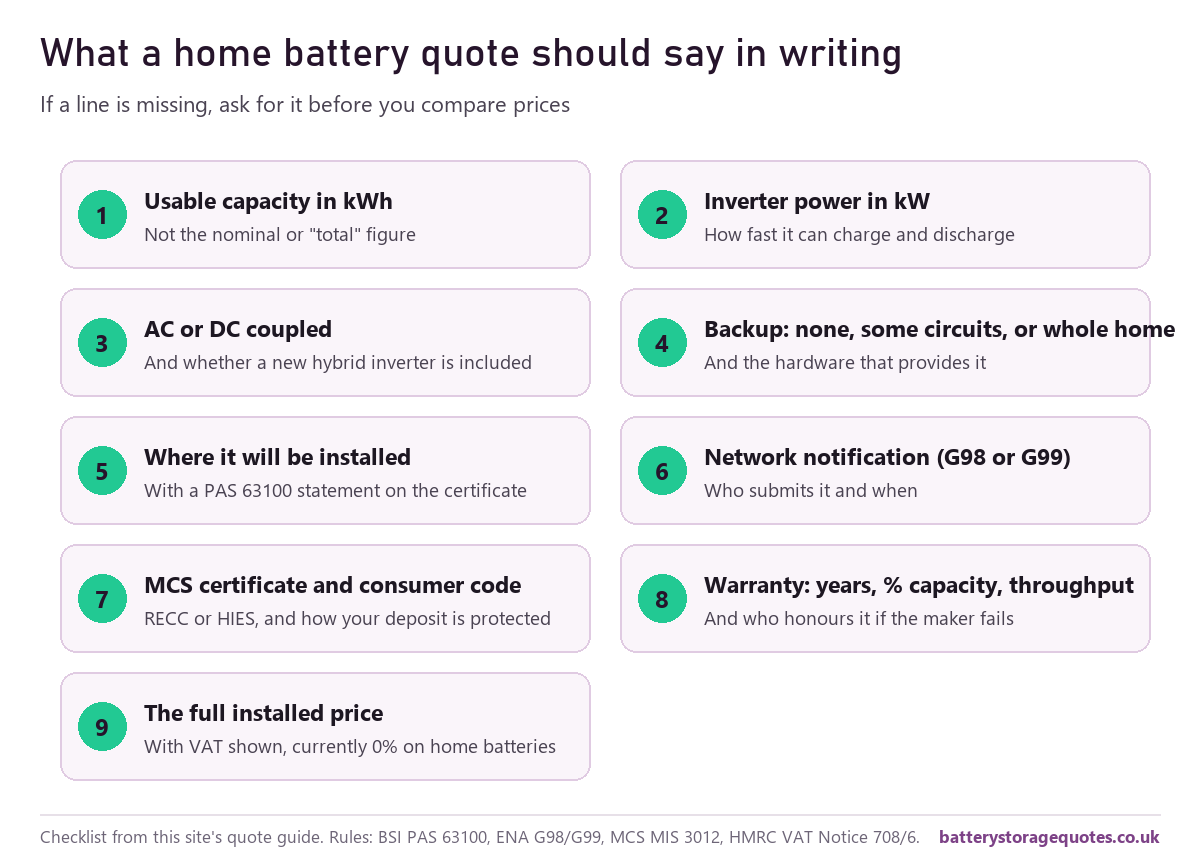
Choose a battery installer who is MCS certified for battery storage (standard MIS 3012), a member of a consumer code such as RECC or HIES, and registered with an electrical competent person scheme. Check each on the official register, not the installer's own badges. Expect a survey, a PAS 63100-compliant location, a network notification or application, an MCS certificate and an electrical certificate with a PAS 63100 statement.
The four checks to run on any installer
| Check | Where | What it tells you |
|---|---|---|
| MCS certification for battery storage | MCS Find an Installer (filter by battery storage), or by certificate number | The business is certified to MIS 3012, the MCS battery installation standard. MCS certifies installers and installations, not battery products. |
| Consumer code membership | RECC member database (search by postcode and technology) or HIES Find an installer | Your deposit and workmanship guarantee are protected, and there is a complaints route. |
| Electrical competent person scheme | The electrical competent person register on GOV.UK’s scheme list | The installer can self-certify the electrical work under the Building Regulations. |
| Manufacturer approval | Tesla’s installer finder for Powerwall, or the manufacturer’s own list | For some brands the warranty depends on it. Tesla’s only applies to Powerwalls bought from Tesla or a Tesla certified installer. |
Check the registers yourself. A logo on a van or a website is not evidence; the register entry is.
What a proper installation involves
- A survey. Your yearly use, the supply (single or three phase), the consumer unit, any existing solar inverter and, above all, where the battery can go.
- A compliant location. PAS 63100, the BSI fire-safety specification for batteries in homes, prefers outdoors and rules out bedrooms, escape routes such as hallways and landings, lofts and roof voids, and cellars without outside access. Indoor rooms need 30-minute fire separation and ventilation to outside. See PAS 63100 explained.
- The network paperwork. Under the ENA’s G98 rules, a system up to 16 A per phase (3.68 kW single phase), counting every inverter that can export, is notified to the network operator within 28 days of commissioning (30 days for SP Energy Networks). Anything larger needs an application under G99 before installation. MIS 3012 makes the installer responsible for this.
- Installation and commissioning to BS 7671. Amendment 4 of the Wiring Regulations, published on 15 April 2026, adds a chapter on stationary batteries; the previous edition is withdrawn on 15 October 2026.
- Handover documents: the MCS certificate (MCS says it should arrive within 10 days of commissioning), an electrical installation certificate with a statement of conformity to PAS 63100, warning labels at the supply origin, meter and consumer unit, user instructions for shutdown and alarms, and the warranty registration.
Deposits, cancellation and guarantees
- RECC members must keep a deposit to a reasonable share of the price and never above 25%, and deposit plus any advance payment must not exceed 60%. Deposits must be insured, you get at least 14 days to cancel, and the member must give a written workmanship guarantee of at least two years.
- HIES protects deposits and stage payments up to 25% of the contract value or £5,000, whichever is lower, once the installer registers the contract (within 7 days), and requires an insurance-backed guarantee.
- TrustMark, the government-endorsed quality scheme for work in the home, advises only paying for work that has been done.
RECC is not an insurer: you are only covered if the installer registers your installation with the insurance provider, so ask for the certificate.
Red flags
- A price that is only valid today, or a “limited offer” discount for signing on the spot.
- A quote with no usable capacity, no inverter rating or no stated backup.
- A proposed location in a hallway, loft or bedroom cupboard.
- A deposit above 25%, or payment in full before installation.
- Claims of an “MCS-approved battery”: MCS certifies installers and installations, not battery products.
- Savings figures that assume a tariff you cannot get, such as Octopus Flux without solar panels.
Getting more than one quote
Two or three written quotes for the same usable capacity are the simplest protection, and suppliers that publish prices make good benchmarks: see E.ON Next and Octopus. Put each one through the quote checker, and compare the lines in the quote checklist. If you would like a reply by email, the battery storage quotes request takes four short steps. In Wales the installer also needs to suit the network: battery storage in Wales is split between National Grid Electricity Distribution in the south and SP Energy Networks in the north.
Ask every installer to price the same specification, then hold the totals against the official figures in the solar battery cost guide, or the solar panels and battery cost guide if the quote includes panels.
Questions people ask
How do I find a battery storage installer near me?
Use the official registers rather than adverts: MCS's Find an Installer tool lets you filter by battery storage and location; RECC's member database can be searched by postcode and technology; HIES and TrustMark have their own search tools. You can also ask for quotes through this site, which answers a quote request by email.
Does a battery installer need to be MCS certified?
There is no law requiring it, but MCS certification for battery storage (MIS 3012) shows the installer works to the industry standard, and MCS certification of your solar installation is needed for Smart Export Guarantee payments. Some funding, such as the Warm Homes Loan Scheme, requires an MCS certified product installed by an MCS certified installer.
How much deposit should a battery installer take?
Under the RECC consumer code a deposit should never exceed 25% of the estimated cost, and deposit plus any advance payment must not exceed 60%. HIES protects deposits and stage payments only up to 25% of the contract value or £5,000, whichever is lower. Be wary of anyone asking for more up front.
How long does a battery installation take?
The fitting itself is usually a day for a battery on its own. The timetable is often set by the network: a small system is notified after installation, but a larger one needs a G99 application first, which SSEN, for example, aims to answer within ten working days under its fast-track process.
Do I need to be a Tesla certified installer's customer for a Powerwall?
Effectively yes. Tesla's warranty only applies to a Powerwall bought from Tesla or a Tesla certified installer, and installation by anyone else is a listed reason to void it. Tesla's installer finder searches by postcode.