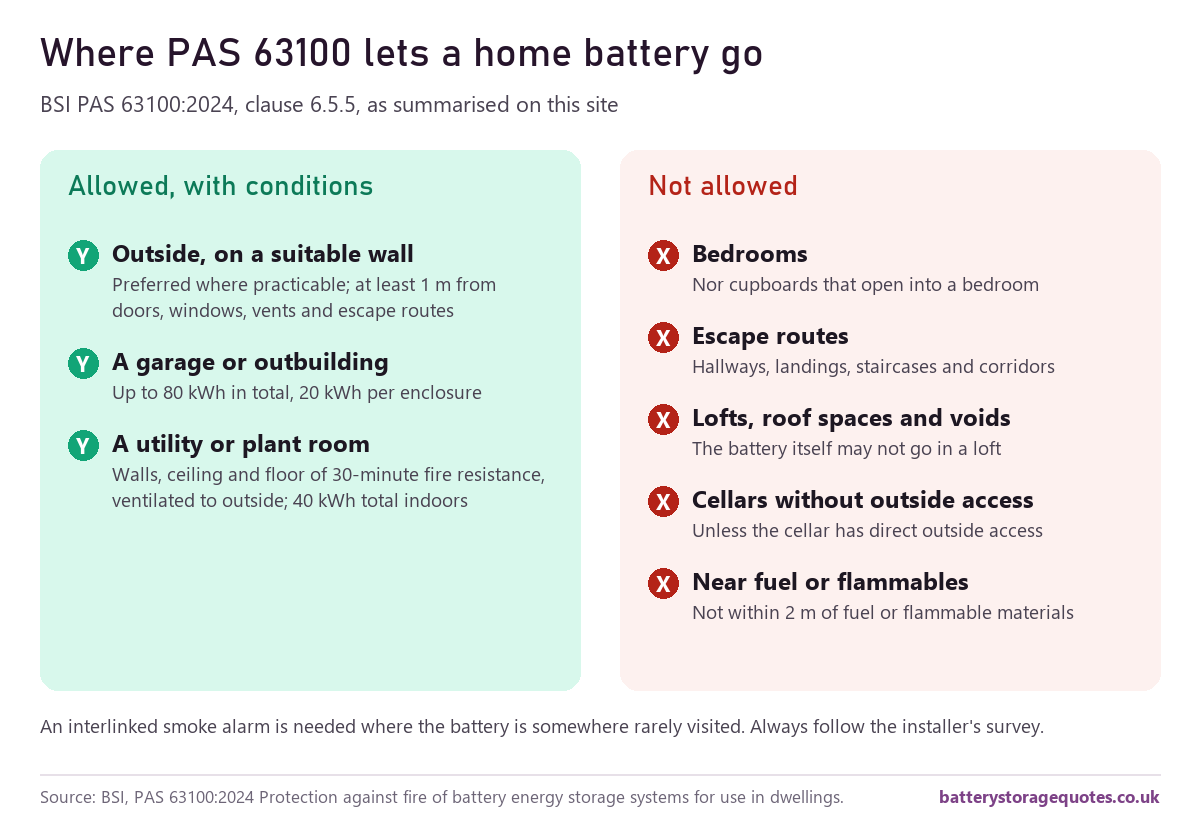
PAS 63100 prefers batteries outdoors. It rules out bedrooms (and cupboards opening into them), escape routes such as hallways, landings and staircases, voids, roof spaces and lofts, and cellars without outside access. Outdoors a battery must be at least 1 m from doors, windows, vents and escape routes, and 2 m from fuel or flammables. Indoor rooms need 30-minute fire separation and ventilation to outside, and one enclosure may hold no more than 20 kWh. It is a voluntary specification, but BS 7671 Amendment 4 (published 15 April 2026; the previous edition is withdrawn on 15 October 2026) includes a regulation telling installers to take account of it.
What PAS 63100 is
PAS 63100:2024, “Protection against fire of battery energy storage systems for use in dwellings”, was published by BSI on 20 March 2024 and took effect on 31 March 2024. It was sponsored by the Department for Energy Security and Net Zero and developed with a steering group that included MCS, the IET, NAPIT, Electrical Safety First and the National Fire Chiefs Council. Its location rules draw on the US standard NFPA 855, and its own introduction states the premise plainly: the best place for a storage battery is outside the home, away from habitable rooms.
A PAS is not a British Standard, and it is reviewed at least every two years. Its authors are candid that battery fires are rare but have a high impact, because some batteries can produce jet-like flames, and that the knowledge about how well fire compartmentation resists lithium battery fires is still incomplete. That is why the rules lean so heavily on location and early warning.
What it does not cover. The scope clause excludes dwellings over 200 m² of floor area (where the same principles can be applied with a fire safety expert), high-risk residential buildings, systems built from second-life batteries, systems above low voltage, batteries connected before the meter or cut-out, and small batteries of 150 Wh or less inside other products. If your home or system falls in one of those groups, PAS 63100 is a guide rather than the specification that applies.
Is PAS 63100 mandatory? How a voluntary specification reached your installer’s rulebook
On its own it is voluntary. The chain from the specification to the work an installer does on your wall has four links, and the last two are new:
| Document | Date | What it says about PAS 63100 |
|---|---|---|
| PAS 63100:2024 (BSI) | 20 March 2024 | A voluntary specification, not a British Standard. |
| IET Code of Practice for Electrical Energy Storage Systems, 3rd edition | cited by MCS, May 2024 | PAS 63100 “should be considered” (clause 11.2.2) and “should be used” for battery location (11.2.3). The IET defines “should” as a recommendation. |
| MCS MIS 3012:2025, the Battery Installation Standard | 1 January 2025 | Requires every MCS battery installation to be designed and installed to the latest IET Code of Practice. It does not name PAS 63100, but its own clauses keep escape routes clear and require a battery to be located so a fire does not compromise protected escape routes. |
| BS 7671:2018+A4:2026, the Wiring Regulations | published 15 April 2026; previous edition withdrawn 15 October 2026 | A new Chapter 57 covers stationary secondary batteries. Regulation 570.6.7.203, as summarised in the Electrical Distributors’ Association’s briefing, requires batteries in dwellings to be installed in a suitable location taking account of the manufacturer’s instructions and PAS 63100. |
MCS said in May 2024 that PAS 63100 had no standing in UK regulations such as the Building Regulations, and the Building Regulations are a separate system from all of the above. So no statute names it; but a competent installer who ignores it would be departing from the IET Code that MCS requires, and from 15 October 2026 from a regulation in the Wiring Regulations as well. In practice, if your quote puts a battery somewhere PAS 63100 rules out, treat that as a reason to ask questions.
The Electrical Distributors’ Association slides are a trade-body summary of the regulation, not the published text of BS 7671, so check the exact wording of Regulation 570.6.7.203 with your installer or the IET.
Where a battery cannot go
Clause 6.5.5 lists the excluded locations:
| Excluded location | Notes |
|---|---|
| Rooms where people sleep | And storage cupboards or spaces that open into them |
| Escape routes that are not protected | Landings, staircases and corridors |
| Protected escape routes and firefighting areas | Corridors, stairs, lobbies and shafts |
| Voids, roof spaces and lofts | The battery itself; see the inverter exception below |
| Cellars or basements with no outside access | |
| Outdoors, within 1 m of escape routes, doors, windows or vents | Ground or wall mounted |
| Within 2 m of stored flammables or fuel tanks and cylinders | Indoors or out |
Room by room
PAS 63100 names exclusions rather than approving rooms, so this table applies its clauses to the places people ask about most. “Allowed” means no exclusion applies and the listed conditions are met.
| Where | Under PAS 63100 | The conditions that decide it |
|---|---|---|
| Outside, on an external wall or the ground | Preferred | 1 m clear of doors, windows, vents and escape routes; 2 m clear of fuel and flammables; the wall’s fire performance kept intact and service holes fire-stopped; IK10 impact protection or a barrier beside a driveway or a public highway |
| Detached garage or outbuilding not lived in | Treated as outdoors | Counts towards the 80 kWh limit; IK10 protection or a barrier in a garage; an interlinked alarm if rarely visited |
| Attached garage or outbuilding | Allowed with separation | 80 kWh limit only with at least REI 60 fire separation from the house, otherwise 40 kWh; IK10 protection or a barrier |
| Utility room or similar indoor space | Allowed if nothing in the exclusion list applies | REI 30 fire separation from the excluded areas, fresh-air ventilation to outdoors, an interlinked alarm if rarely visited, 40 kWh limit |
| Kitchen, living room or dining room | Not named, rarely practical | The same indoor conditions as a utility room; the PAS itself notes air-tightness rules can make batteries impractical in the habitable parts of a home |
| Under the stairs, hallway, landing, corridor | Excluded where it is an escape route | Applies to the route itself and to spaces opening onto it |
| Bedroom, or a cupboard opening into one | Excluded | |
| Loft or roof space | Battery excluded; inverter allowed | The inverter needs an interlinked alarm in that space |
| Cellar or basement | Excluded without outside access |
Where a battery can go, and the conditions
- Outdoors, where practicable, which the PAS prefers. A detached outbuilding not intended for habitation counts as outdoors, as does one separated from the house by a main wall with at least 120-minute fire performance (REI 120). A battery on an external wall must not compromise the wall’s fire performance: penetrations are fire-stopped and combustible materials behind it are not exposed.
- Indoors, only where none of the exclusions apply, and then the space must be fire-separated from the excluded areas by walls, ceilings and floors of at least 30-minute fire resistance (REI 30), and ventilated to outdoors, with the outside vent at least 1 m from doors, windows and other vents.
- A smoke alarm or multi-sensor fire alarm, interlinked with the rest of the home’s alarms, is required where the battery or inverter is somewhere rarely visited, such as a store cupboard.
Capacity limits
- 20 kWh is the most that can be stored in a single battery enclosure.
- 80 kWh is the total per home if the batteries are outdoors, in a detached garage or outbuilding, or in an attached garage or outbuilding with fire separation of at least REI 60.
- 40 kWh is the total otherwise.
Most home batteries are well inside these limits; they matter for large stacked systems. See 20kWh batteries.
The fire alarm: what the PAS asks for
Two separate requirements are easy to confuse. The first is a rule about where the equipment sits: a battery or inverter in a loft, store cupboard or other rarely visited place needs its own smoke or multi-sensor alarm there, interlinked with the home’s alarms and to BS 5839-6. The second is a general recommendation about the home: a note to the PAS says premises with a battery system should have a fire detection and alarm system of at least Grade D2, Category LD2, meaning alarms in the escape route plus any room with a high fire risk, and that in an existing home this might mean a new system or an upgrade to the existing one when the battery goes in. Ask the installer whether the quote includes any alarm work, because it is easy to miss.
Other requirements worth knowing
- Inverters are treated differently. Power conversion equipment is not banned from lofts, but where it is in a loft, cupboard or other rarely visited place an interlinked alarm is required.
- Impact protection. Batteries beside driveways or parking areas, on walls next to a public highway, or inside a garage or beside indoor parking need IK10 impact protection or barriers; the matching inverter requirement is IK08. The PAS notes that barriers in some of these places may need planning permission, in which case another location should be chosen.
- Enclosures must be non-combustible (steel is the example given) with the protection devices inside, and the interior accessible only with a tool.
- Arc-flash classes. The battery maker declares the arc-flash energy of its product. Above 8 cal/cm² a battery is not considered suitable for homes at all; between 4 and 8 it must split into blocks below 4 and have an enclosure rated REI 60; at 1.2 to 4 the cells must be reachable only with a tool.
- Warnings and alarms. Systems inside a home must give an audible warning of a dangerous battery condition; outdoor ones may use app monitoring instead.
- Labels showing a battery is present go at the origin of the installation, at the meter if it is separate, and at the consumer unit.
- Plug-in batteries are a separate question. PAS 63100 covers batteries installed in homes. The 2026 plug-in solar regulations do not extend to a plug-in solar battery, and DESNZ’s planned safety study will review where standards such as this leave gaps for plug-in ones.
The paperwork to ask for
PAS 63100 asks the installer to provide a statement of conformity against PAS 63100, added to the BS 7671 electrical installation certificate, plus user instructions covering start-up, shutdown, alarms and what to do if the battery is damaged. Its Annex C sets out a suggested form with room for the installer to list any exceptions, and Annex B is a clause-by-clause verification checklist. Ask for the completed statement by name. It is the simplest evidence that the location and installation were checked against the specification, and it matters again when you sell the house.
What changes on 15 October 2026
BS 7671:2018+A4:2026 can be used for new work from its publication on 15 April 2026. The previous edition, with its 2024 amendment, stays current until 15 October 2026 and is then withdrawn. After that date an installer designing a new home battery works to the Amendment 4 text, including its new Chapter 57 on stationary secondary batteries and the location regulation that points to PAS 63100. The practical effect for a buyer is small if the installer already follows the IET Code, and larger if they have been fitting batteries in lofts or hallways because nothing forced them not to. The BS 7671 Amendment 4 explainer lists what else the new chapter changes.
How it fits with the other rules
- BS 7671, the Wiring Regulations: Amendment 4 adds Chapter 57 and widens the scope of the regulations to include stationary secondary batteries that store and supply electrical installations.
- MCS MIS 3012:2025, the battery installation standard, requires installation to the latest IET Code of Practice for Electrical Energy Storage Systems, with BS 7671 taking precedence if the two conflict.
- The Building Regulations may apply to external equipment and electrical work; PAS 63100 notes that equipment on an external wall can sometimes need building control or planning consent.
What it means for your quote
Ask every installer where they propose to put the battery and why that spot complies. A quote that assumes a loft, a hallway or a bedroom cupboard is not a real price, and a compliant alternative (an outside wall, a garage, a fire-rated enclosure) may cost more. Comparing battery storage quotes on the same location is the only fair comparison.
Questions people ask
Is PAS 63100 mandatory?
Not as a law. It is a voluntary BSI specification, and in May 2024 MCS said it had no standing in UK regulations such as the Building Regulations. But the rules installers work to now point at it. The IET Code of Practice for Electrical Energy Storage Systems, which MCS's battery standard MIS 3012:2025 requires installers to follow, says PAS 63100 should be used for battery location, and BS 7671 Amendment 4, published on 15 April 2026, includes Regulation 570.6.7.203, which tells installers to take account of it for batteries in dwellings. The previous edition of the Wiring Regulations is withdrawn on 15 October 2026.
Does PAS 63100 apply to a battery I already have?
The specification sets fire-safety requirements for the installation of home battery systems and gives no deadline for upgrading older ones. If yours was fitted before March 2024 in a loft, hallway or bedroom cupboard, ask the installer to review the location against it, and tell your home insurer. The PAS also says a home with a battery should have a fire alarm system of at least Grade D2, Category LD2, which in an existing home may mean a new or upgraded system.
Do I need a smoke alarm for a home battery?
Yes in some places. Where a battery or its inverter sits in a loft, store cupboard or other rarely visited spot, PAS 63100 requires a smoke or multi-sensor alarm in that space, interlinked with the home's other alarms. More generally it says a home with a battery should have a fire detection and alarm system of at least Grade D2, Category LD2.
Which homes does PAS 63100 not cover?
Dwellings over 200 m² of floor area, high-risk residential buildings, systems built from second-life batteries, systems above low voltage, and batteries connected before the meter or cut-out. It also excludes small batteries of 150 Wh or less built into other products. For a large house its notes say the same principles can apply, but a fire safety expert should be consulted.
Can a home battery go in the loft?
No. PAS 63100 rules out voids, roof spaces and lofts for the battery itself. Power conversion equipment such as an inverter can go in a loft if an interlinked smoke or heat alarm is fitted there, but the battery cannot.
Can a battery go under the stairs or in a hallway?
Not if that space is part of an escape route. PAS 63100 excludes routes used as a means of escape, including landings, staircases and corridors. It does not name 'under the stairs' as a location, but a cupboard under the stairs in a hallway is usually part of the escape route.
Can I put a battery in my garage?
Usually, yes. A detached garage or outbuilding counts towards the 80 kWh limit, and so does an attached one with fire separation of at least REI 60 from the house; otherwise the limit is 40 kWh. Batteries inside a garage need IK10 impact protection or a barrier, and the garage must be somewhere an alarm and ventilation can be provided.
Where can I download PAS 63100?
BSI offers PAS 63100:2024 as a free download after a short registration on its Knowledge site. It is also sold through standards resellers.