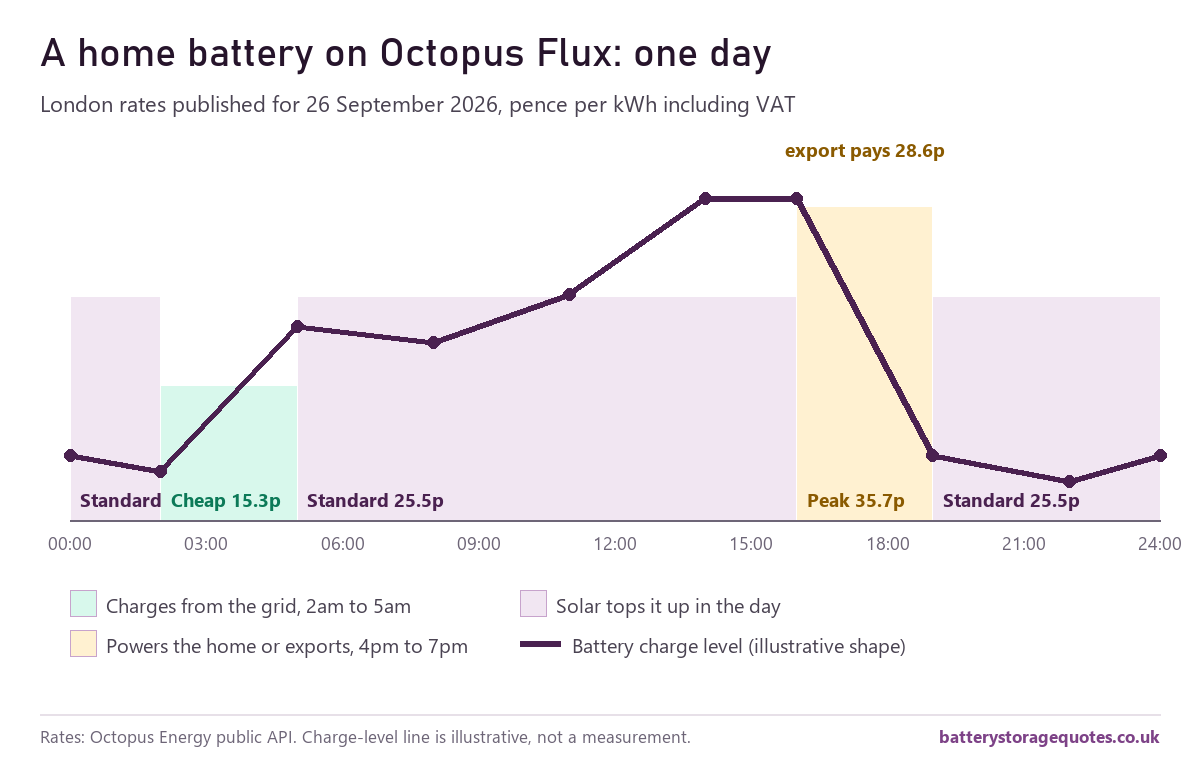
With solar and a battery, Octopus Flux is the usual starting point: a cheap rate from 2am to 5am, a peak from 4pm to 7pm and export in the peak at about 27p to 31p depending on region. It needs solar panels and a home battery. Without solar, Agile Octopus (half-hourly prices) is open to any smart-meter customer, and British Gas Charge Power is built for homes that already have a battery. Octopus Go needs an electric car charged at home, and Cosy needs a heat pump or electric heating.
The battery tariffs and who can use them
| Tariff | Who can join | How it pays a battery |
|---|---|---|
| Octopus Flux | Homes with solar panels and a home battery (any installer), an export MPAN, the MCS certificate and a compatible smart meter | Cheap import 2am to 5am, peak import and higher export 4pm to 7pm |
| Intelligent Octopus Flux | Solar plus a compatible battery; marked temporarily unavailable on 7 October 2026, and exclusive to customers who bought solar and a battery from Octopus | Octopus controls charging and exports in the peak |
| Agile Octopus | Any Octopus customer with a compatible smart meter | Half-hourly prices set a day ahead, capped at 100p per kWh, sometimes negative |
| British Gas Charge Power | British Gas customers with a home battery, with or without solar, a smart meter sending half-hourly readings and a fixed Direct Debit | Half-price electricity from midnight to 5am; works with all batteries |
| Octopus Go / Intelligent Octopus Go | Octopus says you must have an electric car that you charge at home; Intelligent Go needs a compatible car and charger | A cheap overnight window for the whole home (Go: 00:30 to 05:30; Intelligent Go: 11:30pm to 5:30am), with a £50 early exit fee |
| Cosy Octopus | Homes with a heat pump, electric radiators or an electric boiler | Three cheap periods a day: 4am to 7am, 1pm to 4pm and 10pm to midnight |
| Outgoing Octopus (export) | Octopus customers with an export MPAN | 12p per kWh for every unit exported, variable; Prime Outgoing pays 16p from 4pm to 7pm and 9p otherwise |
Octopus appears here because it publishes every regional rate through a public API, which makes a like-for-like comparison possible; it is not an endorsement. Octopus also sells and installs batteries itself, and its prices, packages and the rules on who can join which tariff are on our Octopus home battery page. Other suppliers offer time-of-use and export tariffs too, many of them aimed at electric vehicle owners. Check eligibility on each supplier’s own page before you buy a battery on the strength of a tariff.
Octopus Flux rates in every region
On 28 October 2026 standard Flux rates across the 14 regions ranged as follows (pence per kWh, no VAT on household electricity since 1 October, after the rise of about 10% on 19 October):
| Rate | Lowest | Highest |
|---|---|---|
| Import, 2am to 5am | 15.41p (East Midlands) | 16.94p (Merseyside and North Wales) |
| Import, standard | 25.53p (East Midlands) | 28.05p (Merseyside and North Wales) |
| Import, 4pm to 7pm | 35.64p (East Midlands) | 39.16p (Merseyside and North Wales) |
| Export, 4pm to 7pm | 28.90p (East Midlands) | 31.75p (Merseyside and North Wales) |
| Daily standing charge | 42.29p (London) | 66.74p (Merseyside and North Wales) |
In London the figures were 16.17p, 26.78p and 37.38p for import and 30.31p for peak export. The full table for every region, with export in all three periods, the Intelligent Flux import rates and the standing charge rise of 19 October, is on the Octopus Flux rates page. Source: Octopus Energy public API, read 28 October 2026.
Choosing, by the kind of home
- Solar and a battery: Flux. The model’s regional savings for a 10 kWh battery with 4 kWp of solar run from about £379 to £455 a year on Flux against £141 to £181 on a flat tariff. If the solar is already on the roof, the retrofit solar battery guide shows the paybacks by array size and tariff.
- A battery and no solar: Agile Octopus or British Gas Charge Power, unless you have an electric car. A back-test on 12 months of real Agile prices puts a 10 kWh battery-only saving at £268 to £346 a year against Flexible Octopus, of which £239 to £266 is the battery’s own. See batteries in homes with no solar panels.
- An electric car: an overnight EV tariff charges the car and the battery cheaply and lets the battery cover the house by day. On Octopus’s 14 October 2026 rates this site’s model puts a 10 kWh battery-only home on Go at £430 to £547 a year, depending on region and on whether it takes the variable or the new 12-month fixed product, if it qualifies.
- A heat pump: Cosy Octopus’s three cheap periods suit a battery that tops up between them.
Agile on a year of real prices
Over the 365 days to 13 October 2026, Agile Octopus averaged 20.3p in London (24.4p in North Scotland). The evening peak, 4pm to 7pm, averaged 35.2p in London and each day’s cheapest three hours 12.5p. The dearest half-hour was 86.7p, and 484 half-hours, 2.8% of the year, were priced below zero. A 10 kWh battery that knew each day’s prices, in a home using 3,000 kWh a year, would have saved between £239 and £266 on its own depending on region, and moving to Agile at all would have saved a home between £3 (North Scotland) and £105 (London) before any battery. The 12-month back-test explains the method and why batteries above 10 kWh added nothing.
Export: what you are paid for
The Smart Export Guarantee, launched on 1 January 2020, requires suppliers with at least 150,000 domestic customers to offer an export tariff for electricity from eligible generation such as MCS-certified solar. Ofgem’s guidance says that where an export meter also records electricity from a battery charged from something other than the eligible generator, the supplier is not obliged to pay SEG rates for it, though it may choose to. Flux pays for exports including battery exports in the peak, which is why it suits a battery. Octopus’s own export tariffs pay 12p flat (Outgoing Octopus), 16p from 4pm to 7pm and 9p otherwise (Prime Outgoing), a half-hourly price (Agile Outgoing) and 4.1p (the Smart Export Guarantee tariff, for export-only customers). The Octopus export tariff comparison shows what Agile Outgoing paid over the last 12 months in each region and when Prime beats the flat rate.
Octopus’s new Charge Pack add-on pays at least £12 a month for letting Octopus use a supported battery in about two grid-balancing sessions a week. It works with Go, Intelligent Go, Flexible or fixed import tariffs alongside Outgoing Octopus, and cannot be combined with other third-party battery schemes.
The price cap and the VAT cut
Ofgem’s price cap for 1 October to 31 December 2026 is 26.32p per kWh with a 54.83p daily standing charge (GB average, direct debit), and it does not include VAT, because the government has removed VAT from household electricity bills from 1 October 2026 to 31 March 2027. Octopus’s Flux import rates fell by that 4.8%, which shrinks every import gap by the same proportion while export rates stay the same. The Flux rates on this page and on the Octopus Flux rates page are from 7 October 2026, after the change.
Getting the tariff right before you buy
Ask any installer which tariff their payback figure assumes, and whether your home is eligible for it. A payback modelled on Flux for a home without solar, or on an EV tariff for a home without a car, is not a payback you can have. The calculator only offers Flux when you have solar. When the tariff is settled, compare battery storage quotes on the same basis, and to price the whole system see the solar panels and battery cost guide.
Questions people ask
Which Octopus tariff is best for solar and a battery?
For most homes with both, Octopus Flux: it charges the battery cheaply between 2am and 5am and pays a higher export rate from 4pm to 7pm. Intelligent Octopus Flux, which lets Octopus control the battery, was marked temporarily unavailable on Octopus's page on 7 October 2026, which also said it was exclusive to customers who bought solar and a battery from Octopus.
What are the Octopus Flux rates?
They vary by region. In London on 28 October 2026 standard Flux import was 16.17p (2am to 5am), 26.78p (standard) and 37.38p (4pm to 7pm), with export at 4.72p, 11.11p and 30.31p for the same periods; import has carried no VAT since 1 October, and Octopus raised the unit rates by about 10% on 19 October. The page on Octopus Flux rates lists every region.
Can I get Octopus Flux without solar panels?
No. Octopus says Flux is for solar and battery owners: you need a solar system and a home battery (neither has to have been installed by Octopus), a smart meter with half-hourly readings, an export MPAN and your MCS certificate. Battery-only homes usually look at Agile Octopus instead.
Is Agile Octopus good with a battery?
It can be, because a battery can charge in the cheapest half-hours of each day and cover the dearest. Over the 12 months to 13 October 2026 in London the average of each day's cheapest three hours was 12.5p and the 4pm to 7pm average 35.2p, and a 10 kWh battery in a home using 3,000 kWh a year would have saved £239 on its own. Across the 14 regions that ranged from £239 to £266. Prices are capped at 100p per kWh and can go negative: London had 484 half-hours below zero in the year.
Is there a battery tariff that does not need solar or an electric car?
British Gas's Charge Power is built for customers who already have a home battery, with or without solar. British Gas says it gives half-price electricity from midnight to 5am, works with all batteries and needs a smart meter sending half-hourly readings and a fixed Direct Debit. Agile Octopus is the other option open to a battery-only home. Octopus Go needs an electric car, and Cosy needs a heat pump or electric heating.
Will the VAT cut change battery savings?
Slightly. VAT on household electricity is removed from 1 October 2026 to 31 March 2027. Octopus passed it on: its Flux import rates, excluding VAT, were unchanged between 26 September and 7 October, so the prices including VAT fell by 4.8%, which narrows the gap between cheap and dear hours by the same proportion. Export rates carry no VAT and are unaffected.